Hi there! Someone in your town just heard your name from a neighbor, or drove past your sign, or picked up your card. Then they did the only thing left to do: they typed your business name into Google. What came back is your reputation. The whole test took about forty seconds.
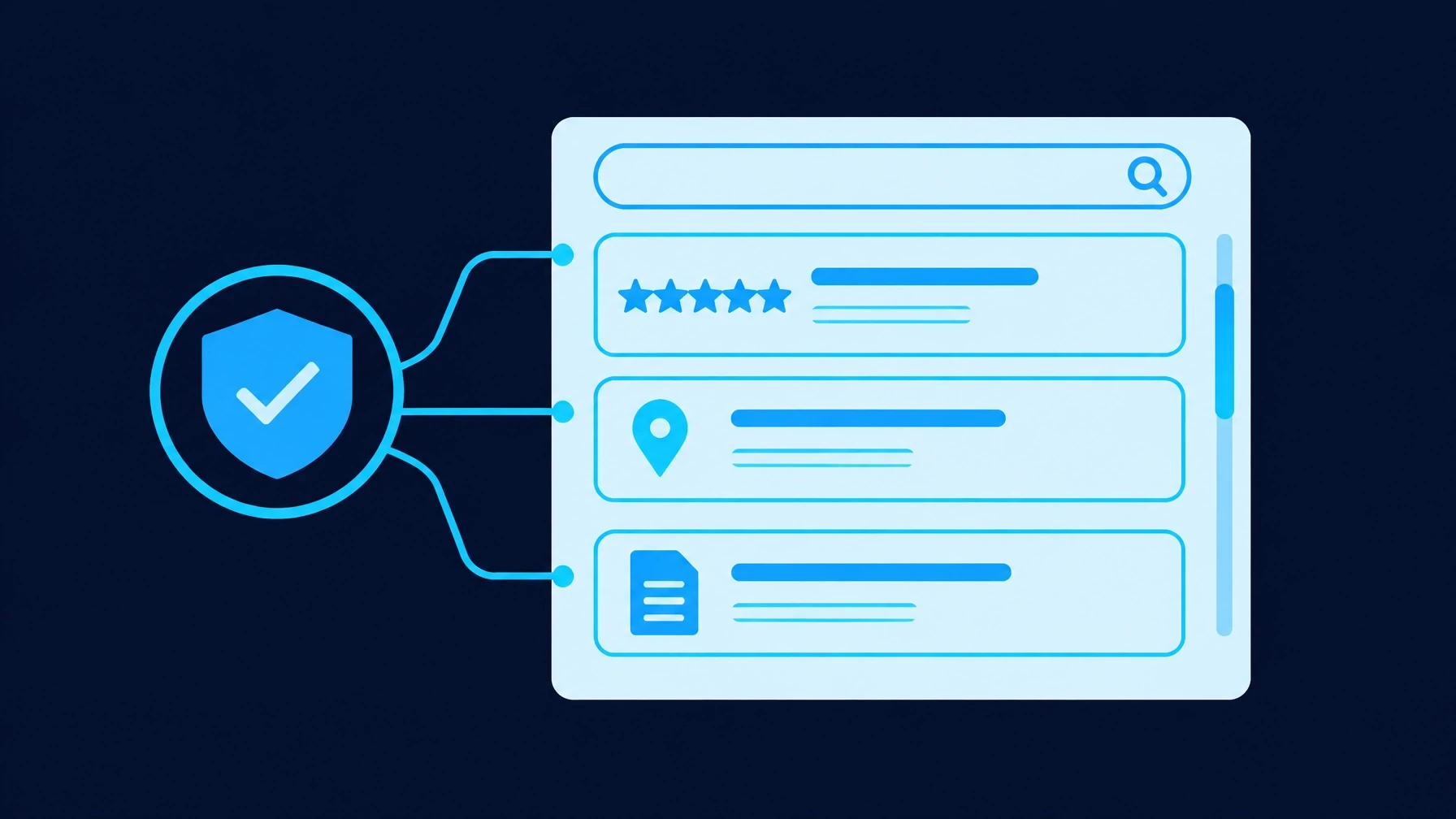
The Name Search Is the Whole Test
Most owners assume a reputation problem, if they have one, shows up on the “near me” search. It usually doesn’t. The near-me search is where strangers find you. The name search is where the people who already found you decide whether to call.
Those are two different questions. The near-me search asks “who is in my area.” The name search asks “is this business real, current, and worth the drive today.” You can rank beautifully for your service and your town and still lose the job at the name search, because nothing on that page answers what the customer is actually holding in their head.
They are not checking your star rating for fun. They are looking for one specific thing to worry about, and they will find it if it is there.
Three Zones, and Only One Is Yours
Look at your own name search and it splits into three parts.
The first zone is what you own: your website, your Google Business Profile, the service pages you wrote. You control every word of it.
The second zone is what you half-own: directory listings, review platforms, social profiles, industry and association pages. The information there came from you once and then stopped being yours the day you changed something.
The third zone is what you do not own at all: a forum thread, a local news mention, a competitor page comparing themselves to you, a photo someone else uploaded. You can influence the last zone. You cannot edit it.
An honest online reputation management conversation starts by sorting those three zones, because the fix is different for each one, and most owners have spent money on the third before they finished the first.
The Results You Forgot You Own
Before you look at anything you cannot control, look at the claims still being made on your behalf.
An old address from a move in 2023. A second location that closed and was never marked closed. The previous owner’s phone number, still live on four directory sites. Hours that say five o’clock when you close at six. A category broad enough to mean nothing, like “contractor” when you only do roofs.
None of that shows up as a complaint. It shows up as a stranger quietly deciding you are probably not the one, and it is invisible from inside your own business, because your customers who already know you never see those pages.
Cleaning up the places your business information lives is the most boring part of reputation work and the one that changes the page fastest. If you want it handled across every directory and voice platform in one pass, that is what Business Listings & Voice Search covers.
When the First Page Isn’t Yours
Sometimes the name search is a fight. A competitor buys a page built around “alternatives to you” and it ranks second. A single angry review sits on page one because it is recent, in a sea of good ones that are two years old. A community group thread from 2022 still answers questions about your pricing in a voice you never approved.
Here is the part owners hate: you cannot delete your way out of most of it, and the removal rules are narrow on purpose. What you can do is make the page you want to be read the easiest thing to find, and make the reply to the complaint the calmest thing on the page. A reader weighing a four-paragraph complaint against a measured three-line reply usually believes the reply.
Reviews are the levers here. Recent, specific reviews push older noise down the page simply by existing. That is what Review Generation & Reputation is built around, and it is why volume with no recency does far less than most owners expect.
Run the Test Yourself Once a Month
This takes twenty minutes and almost nobody does it.
Open a private browsing window, so you are not signed into anything that personalizes results. Search your exact business name, then your name plus your town. Note what fills positions one through five, whether the address and phone match what you have on the door, and whether anything on that page is flatly wrong.
Then do the same search on your phone, off your office wifi, because location and history shape what you see. Take a screenshot and put it in a folder with the month on it. The screenshot is the point: the page changes slowly enough that memory lies, and three months of images will show you things no dashboard reports.
If your own website is not near the top for your own name, that is its own finding, and it is usually a page problem rather than a reputation problem. Winning Websites is the place to start there.
Where Online Reputation Management Actually Fits
Online reputation management is monitoring what is said and shown about you across review platforms and search engines, then improving it on purpose. Not a crisis service, and not a subscription that sends you a report you never read.
In practice it is four jobs running at once: watching the name search and the review platforms for new claims, keeping your business information consistent everywhere it appears, keeping a steady flow of recent reviews arriving so the page stays current, and making sure the pages you own say plainly what you do and who you do it for.
The fourth job is the one owners skip, and it is the one that makes the other three hold.
What to Fix First
The order that works: your records, then the pages you own, then the flow of recent reviews, then the third zone you cannot edit. Doing it in that order means every hour lands somewhere and stays.
If you would rather see the whole path before you start spending, request your roadmap analysis and we will put together a 12-month view of what to fix first, what can wait, and what you can leave alone entirely.
A gap analysis against two or three competitors in your town is a useful way to sanity-check that list once it exists.
Frequently Asked Questions
What does online reputation management actually cover?
It covers what shows up when someone searches your business name, plus everything said about you on review platforms and directories. That includes your own pages, the listings that repeat your details, and the reviews people read before they decide. It is monitoring and improving, not just watching.
Can you remove a bad review or an old article about my business?
Sometimes a review breaks the platform’s own rules and can be reported, and removal rules do exist for specific situations. Most negative reviews are legitimate opinions and will stay up. The realistic work is making the reply strong and making newer, better material easier to find.
How long before the first page changes?
Your own pages and your corrected listings can change within weeks, since those are under your control. Reviews and outside mentions move slowly, and a page that has held the same shape for years will not turn over in a month. Judge it in quarters, not weeks.
Do I need this if my reviews are already good?
Possibly not the review part. A business with steady recent reviews and consistent listings is in good shape and should spend its attention elsewhere. The test is simple: run your own name search and see whether anything on the page is wrong, stale, or answering for you in a voice you did not write.
Share This Article
Found this useful? Send it to another owner who has never typed their own business name into a private window.
Share on Facebook · Share on X · Share on LinkedIn · Share on Pinterest
Want More Information? Let’s Talk.
If you would rather not take this on yourself, we handle it for you. Our Review Generation & Reputation service takes care of the setup and the ongoing work, then reports back so you can see exactly what changed. You keep running your business; we keep this moving.
Call us at 631-825-9464 or reach out here. No pressure, no obligation, and you can ask us anything — including whether this is even worth doing for a business your size.
Looking ahead, request your roadmap analysis and we will map out a 12-month plan to close the conversion leaky bucket so more of the customers you already reach turn into booked work.
Written by Joe Leineke · Content on this blog is generated with AI assistance and independently reviewed and fact-checked by human marketing professionals for accuracy and quality.