Hi there! Every owner knows they miss calls. Very few know what those calls are worth, which is why the choice between an AI answering service, a human answering service and a plain voicemail box usually gets made on price alone. That is the wrong number to compare. Here is the one that matters, and how to work it out for your own business before you sign anything.
Nobody sends you an invoice for a call that went unanswered, so the loss hides. It shows up later as an open slot on Thursday, a quote you never got to send, or a customer who says “I tried calling you” three weeks after they hired someone else.
What a Missed Call Actually Costs
You can put a number on it with three figures you already have.
Start with how many calls a week nobody picks up. Your phone system or call log will show this, and most owners guess low, because nobody hears the calls that never reached them. Next, estimate how many of those would have turned into a booked job. Not all of them: some are suppliers, some are wrong numbers, some were never going to book. One in three is a cautious starting assumption for a service business. Last, take what an average job is worth to you in profit rather than in revenue, since revenue flatters the number.
Multiply the three and you have a weekly figure. Six missed calls a week, two of which would have booked, at $180 of profit each, is $360 a week, or roughly $18,000 across a year of working weeks. Your numbers may be smaller. They are rarely zero, and they are usually larger than the monthly cost of any of the options below.
That is the number to compare an answering option against. Not its price against a competitor’s price.
The Three Ways to Answer a Phone You Cannot Get To
Every option on the market is one of these three, or a mix of them.
Voicemail
It costs nothing beyond your phone bill, which is also its whole appeal. What it actually catches is the caller who already knows you and will try again. The caller who does not know you hangs up and dials the next name on the map. If you run a business where a missed call is genuinely rare, a voicemail box is the correct answer and you can stop reading. For most local service businesses, it is the most expensive option disguised as the cheapest one.
A Human Answering Service
A live person in a call center answers in your business name, follows a script and either takes a message or books into your calendar. It is a mature, well-understood model, and for certain calls it is simply better than anything automated. Callers who are upset, who need to be talked through a complicated job, or who are deciding between you and someone else benefit from a person listening and responding. The tradeoffs are real too: you pay by the minute or the call, quality varies by shift, callers can often tell they are not talking to your team, and a script that was accurate in March is quietly wrong by August unless someone maintains it.
An AI Answering Service
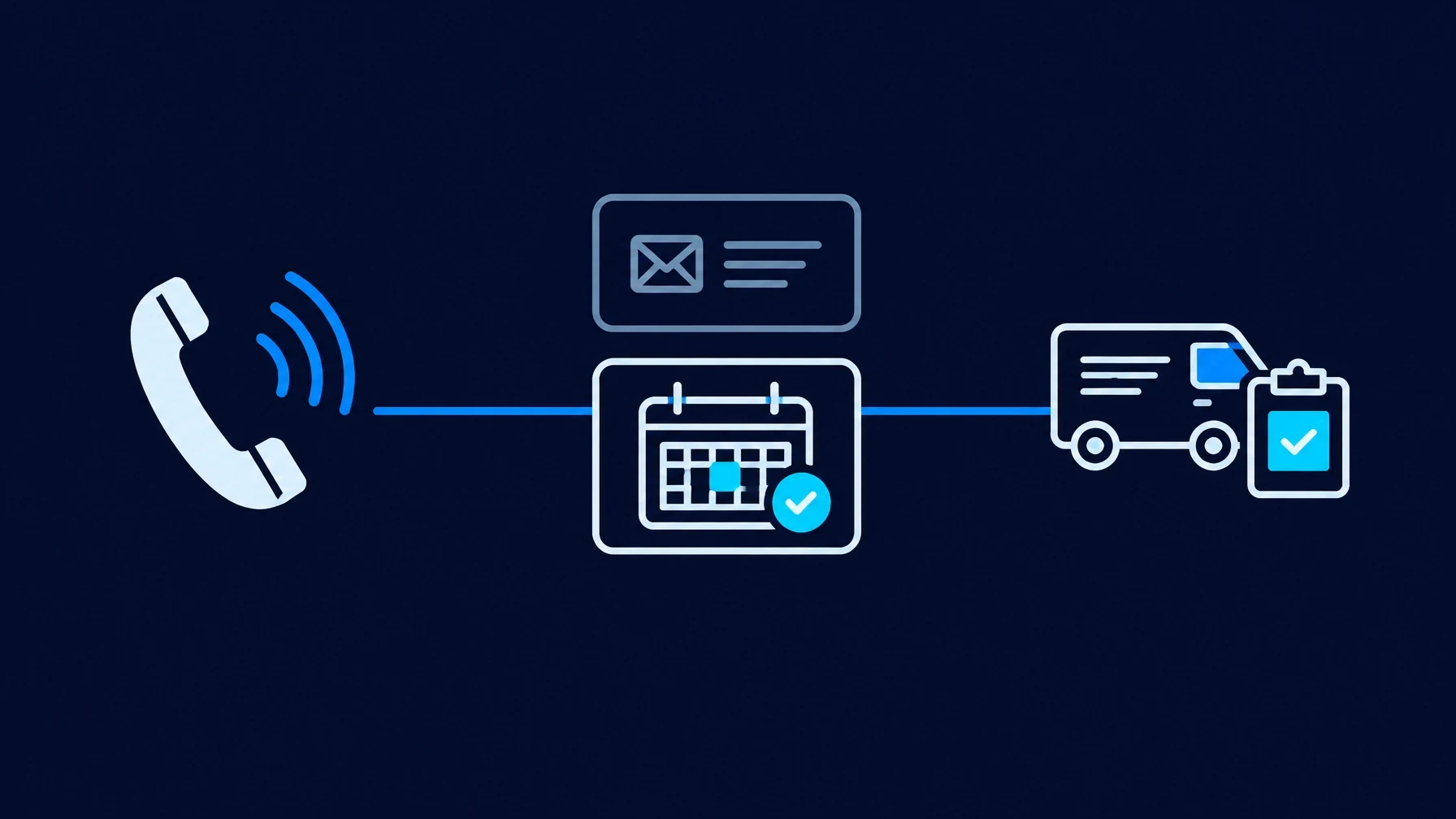
It answers every call immediately, in your business name, at any hour, handles the routine questions, books appointments straight into your calendar, texts your team a summary, and hands the call to a person when a rule says it should. It never gets tired, never sounds rushed at the end of a long day, and does not care whether the call arrives at 7:40 in the morning or during the lunch rush.
What it does not do well is improvise. It is only as good as the questions and answers you feed it, and it has no instinct for the caller who is upset about something that happened on a job last month. The work is in the setup, not the subscription. An AI answering service configured in twenty minutes sounds exactly like one configured in twenty minutes.
Where a Human Answering Service Still Wins
Be honest about this before you shop, because the wrong choice here costs more than the right subscription saves.
If your average job runs into the thousands and almost every call is a real conversation, a person answering is doing sales work, not reception work. A complaint about a recent install needs someone who can apologize, decide and follow up. A caller comparing three quotes needs to be asked questions. Those calls belong with a human, whether that is your own front desk or a live service during the hours that matter.
Plenty of businesses end up with both: a human service covering the working day and an automated one covering the edges. That is not a compromise. It is usually the most accurate answer to the map of when calls actually arrive.
Where an AI Answering Service Wins
The routine question is the strongest case, because it is where automation is genuinely better than a busy person. Hours, service area, whether you take a particular kind of job, what a service call costs to come out, how soon you can get there. Your team answers those fifty times a week and the answers never change.
Then there is the shape of the day. Calls cluster in the hours when everyone is busiest: opening time, lunch, the last two hours before close, and the weekend. Those are exactly the hours a small team cannot cover and a call center covers at a premium.
And there is the record. Every call becomes a transcript, which quietly tells you what people ask for, what they cannot find on your website and where your script is failing. Most owners have never seen a list of the calls they lost. Once you have one, it changes what you fix next.
Five Questions That Decide It
Answer these plainly and the choice mostly makes itself.
First, what share of your calls are routine questions rather than conversations? Above roughly two thirds routine, automation carries most of the volume. Second, what happens to a caller who asks for a person? There has to be a transfer or a fast callback, not a loop. Third, what does an emergency sound like in your trade, and where does that call go? Write the answer down before you turn anything on. Fourth, how does the price behave when volume doubles in your busy season? Per minute billing can turn a cheap month into an expensive one. Fifth, can you hear or read what was actually said on a call? If not, you cannot tune it, and an untuned system stays mediocre.
What to Ask Before You Sign Up
Ask about the contract term and what it takes to leave. Ask what counts as a billable call. Ask whether your number gets forwarded or ported, because that decides how hard it is to reverse. Ask how the system tells callers they are speaking with an automated assistant, since disclosure is both the honest thing to do and increasingly expected. And ask where the call recordings and transcripts are stored and who can see them.
None of those questions are unusual. A provider who answers them without flinching is telling you something useful about how the rest of the relationship will go.
The First Two Weeks
Do not start with the feature list. Start with your own team’s calls. Write down the ten questions your front desk answers most often, in the exact words you want a caller to hear, and load those first.
Then connect the calendar and set the booking rules: which job types the system may book, how far out, and what it must never promise. Then set the handoff, meaning who gets the text summary, how quickly, and what happens at nine on a Saturday night. Then call it yourself from your own phone and try to break it. Every owner who does that finds at least one answer they want reworded.
Read a handful of transcripts every week for the first month. Tune the script rather than switching tools. Most of the value in those first weeks comes from fixing three or four answers, not from adding capability.
If the phone turns out to be one visible leak among several, request your roadmap analysis and we will lay out what to fix first, in what order, across the next twelve months.
Frequently Asked Questions
Is an AI answering service better than voicemail?
For a business that misses more than a handful of calls a month, usually yes. Voicemail only serves callers who already know you and are willing to try again. A system that answers, answers the routine question and books the job keeps the caller who was about to dial your competitor instead.
Will callers know they are talking to a machine?
Often they will, and that is fine. A clear greeting that says what it is, a calm voice and a fast answer to a practical question beat a voicemail box every time. What callers dislike is being misled or trapped, so always offer the route to a person.
Can it book appointments into my calendar?
That depends on your scheduling setup. Most systems connect through an integration with your calendar or booking platform, and the rules you set control what it is allowed to offer. Confirm which integrations are supported before you commit, and test a real booking end to end.
What happens when it does not know the answer?
It should say so, take a clean message and send it to your team rather than guessing. Guessing is the failure mode that costs you customers. Read the transcripts in your first month and add the questions it fumbled to the script.
Share This Article
Found this useful? Send it to another owner who is still letting the phone ring through the lunch rush.
Share on Facebook · Share on X · Share on LinkedIn · Share on Pinterest
Want More Information? Let’s Talk.
If you would rather not take this on yourself, we handle it for you. Our AI Gent service takes care of the setup and the ongoing work, then reports back so you can see exactly what changed. You keep running your business; we keep this moving.
Call us at 631-825-9464 or reach out here. No pressure, no obligation, and you can ask us anything — including whether this is even worth doing for a business your size.
Looking ahead, request your roadmap analysis and we will map out a 12-month plan to close the conversion leaky bucket so more of the customers you already reach turn into booked work.
Written by Joe Leineke · Content on this blog is generated with AI assistance and independently reviewed and fact-checked by human marketing professionals for accuracy and quality.