Hi there! Every owner who has watched a call ring out to voicemail has had the same thought: I should hire someone for the front desk. It is the obvious answer, and sometimes it is the right one. But the thought almost always arrives in a specific moment, and the hire that follows it is a forty-hour commitment to a problem that may be ninety minutes wide.
That mismatch is the whole decision. An AI receptionist and a second front-desk hire are not competing versions of the same purchase. One is labor. The other is coverage. They cost differently, they cover different hours, and they fail in completely different ways.
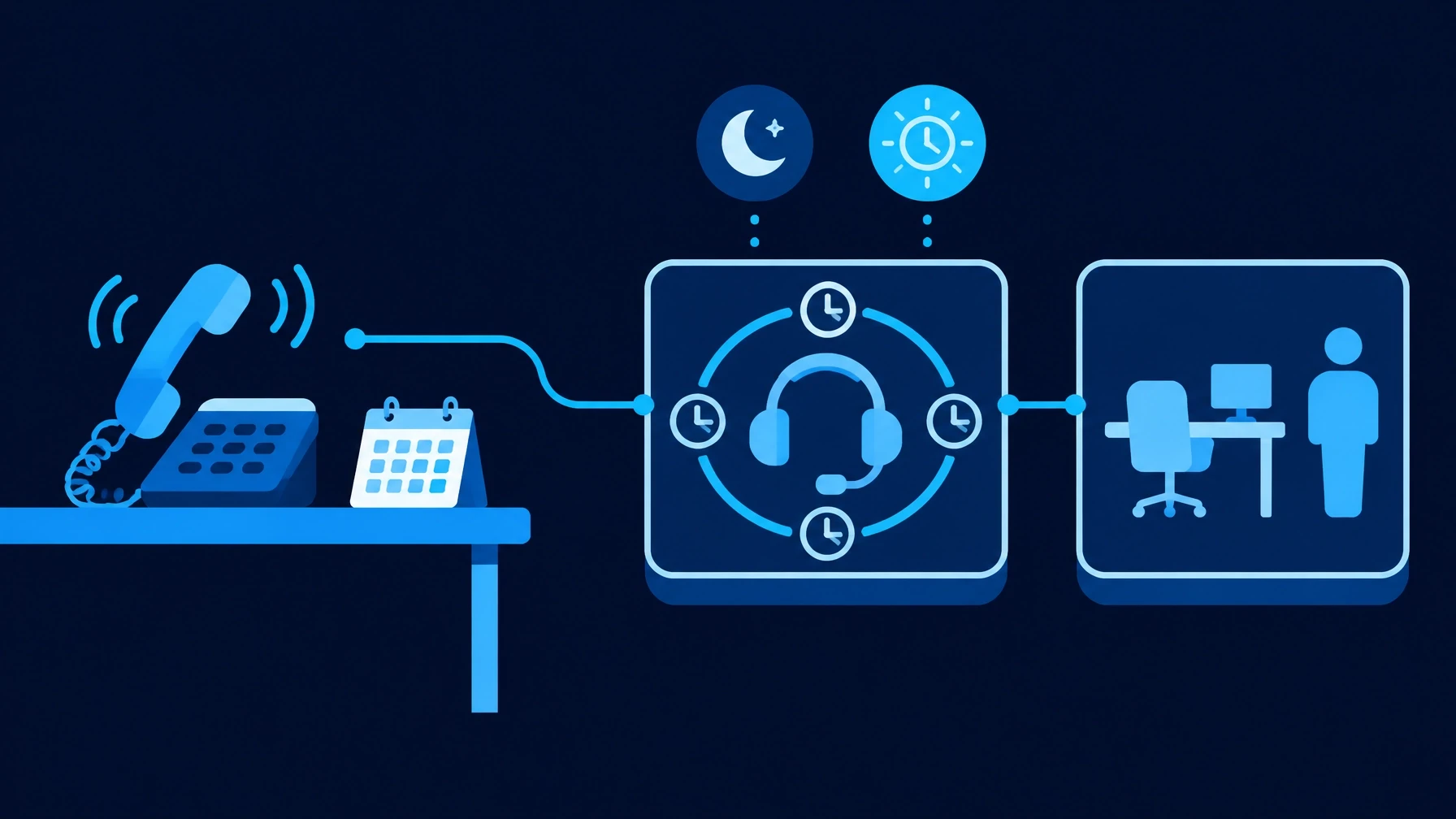
The Hire That Solves a Two-Hour Problem
A front-desk hire is structured as a full-time commitment. You pay for the hours whether or not the phone rings during them, and the person needs a desk, a chair, a system login, and someone to train them.
The problem that made you think about hiring is rarely spread evenly across the week. It is the lunch hour, when one person cannot be on the phone and at the counter at the same time. It is the last hour of the day, when everyone is finishing up. It is Saturday morning. It is the week in July when your one experienced person is on vacation and the phone suddenly belongs to nobody.
You cannot buy six fortieths of a person. That is the whole mismatch, and it is worth sitting with before you post a job.
Count the Calls Nobody Picks Up
Before you compare anything, get the real number instead of the remembered one. Your phone system already logs it.
Four counts matter. Calls that rang and were never answered. Calls abandoned while someone was on hold. Calls that rolled to voicemail. Calls that arrived outside your business hours and got a recording. Pull thirty days of that and look at it by hour and by day, not as one monthly total, because the monthly total tells you nothing you can act on.
The pattern is the argument. If most of the misses land between noon and one, in the final ninety minutes of the day, and on weekends, you do not have a staffing problem. You have three uncovered windows, and no full-time hire is aimed at any of them.
Two more numbers are worth the effort. How many of those callers tried again, and how many of them you never heard from at all. The second group is the expensive one, because a call that goes to voicemail and never comes back usually became someone else’s customer that same afternoon.
Where a Person Still Wins
Any honest comparison has to start here, or the rest of it is a sales pitch.
A person wins on judgment. The caller who is angry and needs to be heard before anything can be scheduled. The insurance argument that requires knowing which plan pays for what. The negotiation over a same-day slot when the schedule is genuinely full and someone has to make a trade. The customer standing at the counter while the phone rings, who can see whether you look after them. Anything where reading a room decides the outcome.
If you listen to your missed calls and most of them are complex, emotional, or negotiable, a tool will not solve that. It will capture those calls faster so a person can handle them badly later, which is a worse outcome than a voicemail in some cases.
What an AI Receptionist Actually Covers
An AI receptionist covers the unstaffed windows and the predictable questions, and it is useful in exactly that order.
Coverage first. After-hours intake: name, number, what the caller needs, and when they can be reached. Appointment requests, worked against whatever calendar access you give it. The questions that cost you a customer when nobody answers them, which are usually only four: your hours, your location and service area, whether you handle their kind of job or take their insurance, and how soon you can get to them.
None of that requires a desk, a lunch break, or a substitute when someone is out. It does not get tired at 4:55 in the afternoon, which is precisely when a surprising share of calls arrive.
What it cannot do is be a person. That sounds like a caveat and it is really an instruction: give it the predictable work, keep the judgment with your team, and tell callers plainly what they are talking to. Coverage is the product. Do not sell yourself on the idea that you have hired anyone.
There is one dependency worth naming. A voice agent answers from your records. If your hours are wrong on two listings and your service area is stale on a third, it will repeat the wrong answer politely, at scale, on every call. That is why the Business Listings and Voice Search work should come first: one accurate source, so the answer is right the first time.
Why the Cost Comparison Usually Fails
The comparison most owners make is hourly wage against monthly subscription. Ignore that one, because neither side of it is a real cost.
The wage is not the cost of a hire. A loaded figure includes the recruiting time before anyone sits at the desk, the weeks of training before they are genuinely useful, coverage for their days off and vacation, and the equipment and software the desk needs. The person who answers your phone in month one costs the most and produces the least, and that is normal, not a failure.
The subscription is not the cost of a tool either. Add the setup, the time to write the scripts that decide what it says, and your own hours spent reviewing calls in the first month. A cheap tool with nobody writing its answers is expensive.
Once both sides are honest, use a denominator that reflects the actual problem: cost per answered call, and cost per captured opportunity, counted only in the hours you were not covering before. A tool that captures eleven after-hours requests a month and a hire who captures those plus everything else is not a fair comparison, because the hire is also doing work you may not need done.
The last axis is flexibility, and owners underrate it. A subscription can be paused for a slow season or a slow quarter. A hire cannot, not without cost and not without a conversation you probably do not want to have in February.
Decide What It Never Touches
Write the boundary before you switch anything on, in plain language, and keep it where your team can see it.
Name three things the agent must never attempt, and what it says instead. The default list is complaints, billing disputes, and anything clinical or legally sensitive. For each one, the correct behavior is the same: take a name and a callback number, say when a person will be in touch, and get out of the way.
The same rule applies to the caller who simply says they want to talk to a person. An agent that keeps trying to be helpful at that point is worse than voicemail, because it is holding someone hostage politely. The right behavior is the handoff, immediately.
The Handoff Is the Part That Fails
The voice is the demo. The record is the product, and the record is where most deployments quietly die.
A shared inbox nobody owns turns a capable phone agent into voicemail with better manners. So decide three things before launch. Where each capture lands, with one named owner rather than a folder several people can see and nobody reads. How fast it gets touched, with same morning as the standard for anything captured overnight. And what happens when it is not touched, which should be an escalation to a person, not silence.
One more thing that is easy to miss: most of these captures want a reply, not a phone call back at whatever hour suits your team. A short message with a real time in it holds the opportunity while the callback is arranged. That is ordinary Email Marketing work, and it is the difference between a capture and a customer.
A Two-Week Test You Can Run Before You Commit
Do not replace your main line. Forward only the windows you found when you counted. After close, the lunch hour, Saturday morning. Since the calls reaching those windows are going to voicemail today, there is nothing to lose while you learn.
Keep your person on the main line so the part of the business that works today keeps working. Then at the end of two weeks, compare captured opportunities against the same two weeks before, and listen to at least ten recordings. Listen for where it stumbled, not for whether it sounded pleasant, because pleasant is easy and accurate is not.
Two weeks of a covered lunch hour is enough to know what you are looking at. At that point the decision is usually clear, and it is often not either one of them alone: the tool covers the windows, the person keeps the judgment work, and the two of you stop having the same conversation every Monday.
If you would rather see the whole sequence before you spend, request your roadmap analysis and we will map a 12-month plan that puts the cheap fixes ahead of the expensive ones.
A gap analysis against two or three businesses in your town is a sensible way to pressure-test that plan once it exists.
Frequently Asked Questions
Will callers know they are talking to an AI?
Assume they will ask, and answer honestly. Most people are fine with a helpful automated system and not fine with being deceived, and disclosure is the right default for trust as well as for the rules in some industries. A one-sentence introduction costs you almost nothing and prevents the alternative, which is a caller who figures it out mid-conversation and distrusts everything after that.
Can it book appointments or just take messages?
That depends entirely on access. If the tool can read and write to your actual schedule, it can hold a slot while the booking stands. If it can only see availability through a form or an inbox, it is a message-taker and should be described that way to your team. Message-takers are still valuable, but they turn into bookings only if the handoff behind them is fast.
Is an AI receptionist cheaper than hiring someone?
Not automatically, and the comparison is usually drawn badly. A full-time hire is a forty-hour commitment plus recruiting, training, coverage and equipment. A subscription is a fixed monthly cost that scales with usage rather than with hours. The answer depends on your volume and on whether your misses sit in unstaffed windows or throughout a fully covered day.
What about a medical or dental office?
Two things change. The information you handle is more sensitive, so the vendor’s data handling needs real review before you switch anything on, and a business associate agreement is usually part of that review, not an afterthought. And the boundary list gets longer, because a phone agent should never give clinical guidance or discuss a patient’s treatment. Keep it on hours, scheduling, location and callbacks.
Share This Article
Found this useful? Send it to another owner who keeps losing calls in the lunch hour and after close.
Share on Facebook · Share on X · Share on LinkedIn · Share on Pinterest
Want More Information? Let’s Talk.
If you would rather not take this on yourself, we handle it for you. Our AI Gent service takes care of the setup and the ongoing work, then reports back so you can see exactly what changed. You keep running your business; we keep this moving.
Call us at 631-825-9464 or reach out here. No pressure, no obligation, and you can ask us anything — including whether this is even worth doing for a business your size.
Looking ahead, request your roadmap analysis and we will map out a 12-month plan to close the conversion leaky bucket so more of the customers you already reach turn into booked work.
Written by Joe Leineke · Content on this blog is generated with AI assistance and independently reviewed and fact-checked by human marketing professionals for accuracy and quality.