Hi there! Ask three dental marketing companies what they sell and you will hear three confident answers that do not match. One talks about your map pack position. One talks about leads and cost per booking. One talks about your recall list. All three call it dental marketing, none of them is lying, and that is exactly why the quotes are so hard to compare.
The word covers at least three separate products. They cost different amounts, they fix different problems, and buying the wrong one is the most common way a good practice spends real money and notices nothing.
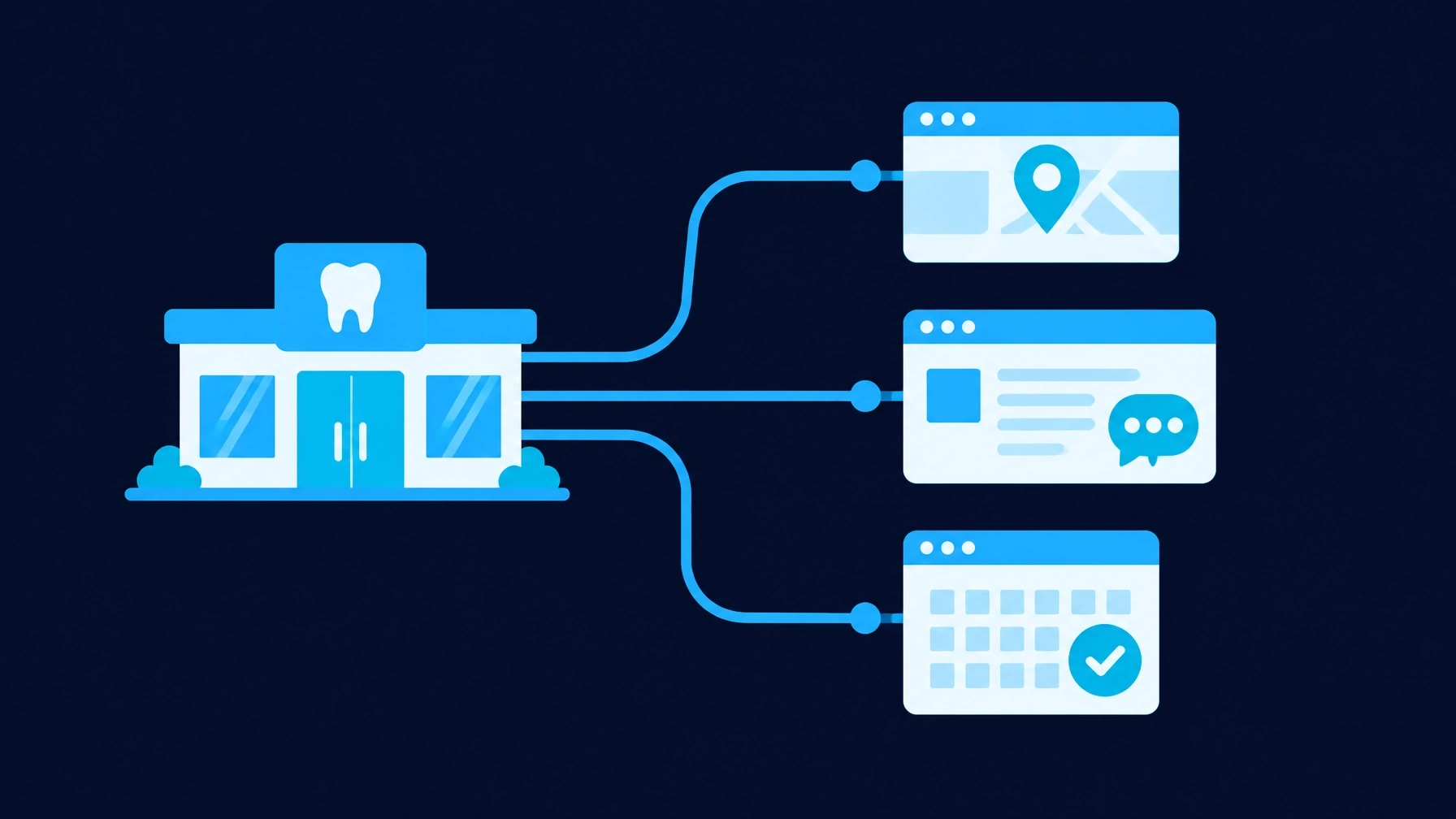
One Word, Three Products
Being found is the first product. That is visibility: showing up when someone searches a dentist in your town, when they search your practice name, and when they ask an assistant for a recommendation.
Turning attention into appointments is the second. That is capture: the page a curious searcher lands on, the phone that gets answered, the form that gets a reply.
Keeping the schedule full is the third. That is the work nobody markets: the no-show, the last-minute cancellation, the treatment plan accepted in principle and never scheduled, the patient who moved across town and quietly stopped coming.
Each one produces a different thing you can count. Visibility produces impressions and positions. Capture produces calls, forms and booked new patients. The schedule produces filled chair time. If a proposal promises one of those and you were hoping for another, the engagement will feel busy and go nowhere.
Product One: Being Found
A practice that is invisible in the map pack is not losing patients to a better dentist. It is losing them to whoever showed up in the first three results on a phone screen.
This layer is unglamorous and mostly mechanical. Your name, address, phone, hours and category have to say the same thing in every place your business appears. Your service pages have to exist as real pages rather than menu items, one for implants, one for emergency visits, one for the new-patient visit, and they have to name the town. Your profile has to be complete and current.
The measurement here is simple and honest: where you appear for the searches that matter and whether the number is climbing. What visibility cannot fix is a phone nobody answers or a page that never states whether you take the patient’s insurance. Those are the next two products, and buying visibility to cover for them is how practices end up with traffic and no bookings.
Location-based searches are their own small discipline, and that is what Near-Me Search Boost is built to handle.
Product Two: Turning Attention Into Appointments
Once someone finds you, they give you about ninety seconds. In that window they want to know whether you are accepting new patients, whether you take their plan, roughly what the first visit involves, and how soon they can get in.
Most practice websites answer none of the four above the fold. The homepage greets them with a mission statement and a photograph of the building, and the answers live three clicks deep in a services menu.
This is where paid advertising either pays for itself or burns. Ads pointing at a page nobody has optimized are the single most expensive way to learn that your website converts poorly. Fix the arrival page first, then buy the traffic, because the same budget against a better page costs less per booked patient and that difference compounds every month.
Conversion work on a practice site is unglamorous too: a booking path that works on a phone, insurance details stated plainly, an obvious phone number, a chat or text option for the person who will not call. That is the ground 4X Conversions covers.
Product Three: The Schedule You Already Own
Here is the part practices underprice: new-patient acquisition is the slowest and most expensive way to fill a chair. The fastest is the patient who already sat in one.
Three leaks live here. The first is the no-show and the late cancellation, which are usually a reminder problem rather than a patient problem. The second is unscheduled treatment, the crown recommended in March that nobody followed up on in April. The third is dormancy, patients who came twice, felt fine, and drifted, and who never received anything from you that gave them a reason to come back.
None of that requires advertising spend. It requires a list, a reason to reach out, and the discipline to send it on a schedule. Routine reminders and recall campaigns are the quiet work of Email Marketing, and they tend to pay for themselves faster than any visibility campaign you will ever run.
What they cannot do is grow the practice beyond the chairs you have. Filling the schedule is a floor, not a ceiling.
Which One Your Practice Actually Needs
You can usually answer this in an afternoon with three numbers.
The first is new patients per month, counted, not estimated. The second is what share of the coming week’s schedule is booked. The third is how many active patients you have now compared with eighteen months ago.
Then read the pattern. Few new patients and open chairs: you have a visibility and capture problem. Plenty of new patients and open chairs: you have a schedule problem, and buying more leads will just make the front desk busier without making the practice healthier. New patients arriving and the schedule full but production flat: the problem is case acceptance, which is not a marketing product at all.
Plenty of practices need two of the three, and that is fine as long as the order is deliberate. What rarely works is buying all three at once from three vendors and letting them each assume the others are handling the phone.
What the Quote Should Tell You
A useful proposal names the output you are buying and how it will be counted. Booked new patients is an output. Impressions are an output. A monthly report of activity is not an output, it is a receipt for effort.
Ask four questions before you sign anything.
What exactly is included, and what gets billed as an extra later? Website changes, call tracking, review requests and content writing are the usual surprises.
Who does the work, and who do I call when something breaks? A named account person beats a generic support address.
How long is the term, and what does leaving look like? A practice should be able to change its mind without losing its own website and its own listings.
What happens to everything when we stop? Your domain, your profile access and your content should belong to you on day one and still belong to you on the day you leave.
A Ninety-Day Order That Does Not Waste Money
Start with the things that cost the least and block everything else. Month one, fix your records and your profile, and answer the four questions on your new-patient page. None of it is exciting and all of it makes the next step cheaper.
Month two, push visibility and put real effort into the arrival page. Month three, open the recall list and start the reminder rhythm. By then you have new patients arriving, a page that converts them, and a list working in the background.
If you would rather see the whole sequence before you spend, request your roadmap analysis and we will map a 12-month plan that puts the cheap fixes ahead of the expensive ones.
A gap analysis against two or three practices in your town is a sensible way to pressure-test that plan once it exists.
Frequently Asked Questions
How much should dental marketing cost?
There is no single number, because the three products have different cost structures. Visibility is mostly labor. Capture is labor plus whatever you spend on traffic. The schedule work is mostly list management. The honest way to compare quotes is to divide the monthly fee by the booked new patients it produced, and to insist on seeing that number rather than a report of activity.
Do I need an agency that only works with dental practices?
Not necessarily, but the vocabulary matters. A generalist who has never written a new-patient page, never handled an insurance question and never worked a recall list will spend your first two months learning your business. Dental-specific experience is worth more on the capture and schedule products than on visibility, which is largely mechanical.
How long before new patients show up?
The schedule work can move in weeks, because the list already exists. Visibility moves over months and rarely in a straight line. Paid traffic moves immediately but costs what it costs. Expect the first ninety days to be mostly foundation work, with measurable movement on the schedule side well before the search side.
Should I run ads or fix my SEO first?
Fix the page and the records first, every time. Ads send paying traffic to whatever exists today, and if today’s page does not answer the insurance and first-visit questions, you are paying to lose people. Once the arrival page converts and the profile is accurate, ads and visibility reinforce each other instead of competing.
Share This Article
Found this useful? Send it to another owner who is still buying leads when the problem is the phone.
Share on Facebook · Share on X · Share on LinkedIn · Share on Pinterest
Want More Information? Let’s Talk.
If you would rather not take this on yourself, we handle it for you. Our Pay-Per-Result SEO service takes care of the setup and the ongoing work, then reports back so you can see exactly what changed. You keep running your business; we keep this moving.
Call us at 631-825-9464 or reach out here. No pressure, no obligation, and you can ask us anything — including whether this is even worth doing for a business your size.
Looking ahead, request your roadmap analysis and we will map out a 12-month plan to close the conversion leaky bucket so more of the customers you already reach turn into booked work.
Written by Joe Leineke · Content on this blog is generated with AI assistance and independently reviewed and fact-checked by human marketing professionals for accuracy and quality.