For a small business, the practical floor to get real signal is $500 to $1,000 a month, and the rule that matters more than any single number is simple: scale spend only after you have proof it works. That is a recommended approach to managing every Meta ads engagement.
TL;DR:
Small businesses should spend at least $500 to $1,000 monthly on Facebook ads to gather meaningful data and exit the learning phase efficiently. CPMs average around $14, but costs can double for smaller audiences or less engaging creative, making audience targeting and freshness crucial. Narrow targeting increases CPM, but broader audiences with high-quality creative often result in better overall efficiency and lower costs per conversion. Higher industry CPMs, such as for finance and legal services, often exceed $20, with CPA targets above $100, requiring careful budget sizing based on margins. Always scale ad spend only after confirming steady CPA and conversion proof over at least 50 events, avoiding abrupt increases that reset learning and spike costs.
How Much Do Facebook Ads Cost in 2026? Benchmarks You Can Trust
Costs climbed faster than results across the platform this year. All-industry median CPM sits near $14, with blended CPC around $1.70 and traffic-specific CPC closer to $0.78.
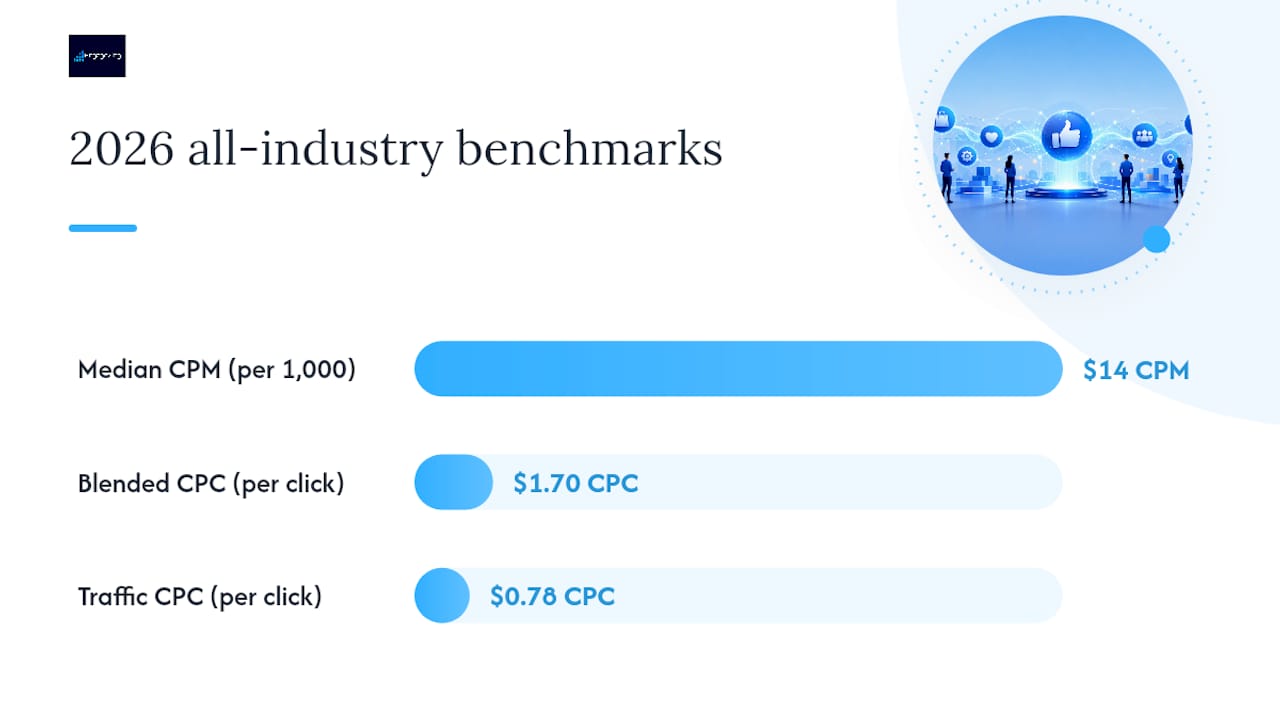
Those numbers only mean something in context. A $14 CPM sounds cheap until you realize your account is paying $22 to reach the same 1,000 people your competitor reaches for $11, because your audience is smaller or your creative is stale. Read your own account against the benchmark, not the other way around.
Objective changes everything. Traffic campaigns keep CPC low but convert weakly, while conversion-optimized campaigns cost more per click yet usually deliver a lower effective CPA because Meta’s delivery system is hunting for buyers, not clickers. Placement matters just as much. Facebook Feed and Instagram Feed tend to run higher CPMs with stronger CTR, while Reels and Stories often come in cheaper on a per-impression basis but demand sharper, native-feeling creative to convert.
Seasonality adds another layer. Fourth-quarter demand from every retailer chasing holiday shoppers pushes CPMs up across nearly every vertical, sometimes 30% to 50% above summer baselines. If you are budgeting for November and December, build in that spike now rather than getting surprised by it later.
A few quick reads on these numbers:
- If your CPM is double the median but your CTR is strong, you are likely fighting a small or overly niche audience, not a bad ad.
- A CPA far above $38 with a healthy CPC usually points to a weak landing page or offer, not a targeting problem.
- ROAS under 1.9x is not automatically bad. It depends entirely on your margin, which the next section walks through.
What Actually Moves Your CPM, CPC, and CPA
CPM is the cleanest signal of auction pressure you have. It reflects how many advertisers are competing for the same eyeballs, and it moves for reasons that have nothing to do with your ad quality: seasonality, industry demand, and how many other businesses are bidding on your exact audience right now.
Audience size and targeting granularity are the biggest levers you control. Narrow an audience down to a tight geographic radius plus three interest layers, and you shrink the pool Meta can bid into, which usually pushes CPM up. Broader audiences with strong creative frequently outperform narrow ones on cost, because Meta’s algorithm has more room to find efficient placements.
Ad relevance and creative fatigue drive cost just as hard as targeting does. An ad that earns strong engagement gets rewarded with cheaper delivery. The same ad run for six straight weeks to the same audience will see CTR decay and CPM creep, even with zero changes to your targeting. Systematic creative and placement testing between Reels and Feed can cut CPM by 20% to 40%, but only when creative gets refreshed regularly and matches the placement’s native format.
Measurement shifts have quietly raised reported CPA without anyone touching their targeting. Shorter attribution windows and privacy-driven data loss mean fewer conversions get counted even when sales did not actually drop. That is one reason benchmarks show CPA rising faster than CPM.
Three warning signs to watch weekly:
- Frequency climbing above 3 to 4 while CTR falls: your audience is worn out.
- CTR dropping for two straight weeks with no creative changes: creative fatigue, not audience fatigue.
- CPA widening while CPC stays flat: your funnel below the click is the problem, not the ad.
Pro Tip: Before you touch your targeting, check your ad relevance diagnostics in Ads Manager. A drop in quality ranking almost always shows up as rising CPM before it shows up anywhere else.
How to Size a Facebook Ads Budget That Actually Makes Sense
Most budget mistakes start with picking a round number instead of working backward from a business goal. A defensible budget starts with three questions and ends with a number you can justify to a partner or a spreadsheet.
- Set your target. Decide how many new customers or leads you need this month. A local HVAC company might need 15 new jobs; an ecommerce store might need 200 orders.
- Set your allowable cost. Look at your margin and figure out the maximum you can pay per lead or per acquisition and still hit a break-even ROAS or better. If your average order profit is $60, you cannot sustainably pay $80 in CPA.
- Multiply to get spend. Target customers times allowable CPA equals your required monthly ad spend, adjusted for your actual funnel conversion rate from lead to sale.
- Apparel and ecommerce: CPM often $6 to $12, CPA frequently under $30 for impulse-priced goods.
- Home and garden: CPM $10 to $18, with CPA varying widely by average order value.
- Beauty and personal care: CPM $8 to $15, strong performance on Reels placements.
- Health and wellness: CPM $12 to $20, higher scrutiny from Meta’s ad review adds friction.
- B2B and SaaS: CPM $15 to $25, CPA often $80 or higher due to longer consideration cycles.
- Finance, insurance, and legal: CPM $20 and up, CPA frequently exceeding $100.
- Hold changes for 72 hours minimum. Every edit resets some or all of the learning phase, which delays the ~50 weekly events Meta needs to stabilize delivery.
- Judge proof, not hope. A campaign has proof when CPA holds steady across at least 50 conversions, not three good days in a row.
- Scale in 20% to 30% increments, not by doubling budget overnight, which tends to reset learning and spike CPA.
- Set a rollback trigger. If CPA rises more than 25% for three consecutive days after a budget increase, roll back to the prior spend level.
- Track blended ROAS across channels, not just Meta’s reported number, since platform-reported results can overstate impact.
- Facebook ads benchmarks 2026 — Conversion Studio
- How much should you spend on Facebook ads? — AdBot
- How to spend your first $500 on Meta ads — Socialeum
Here is that math worked two ways:
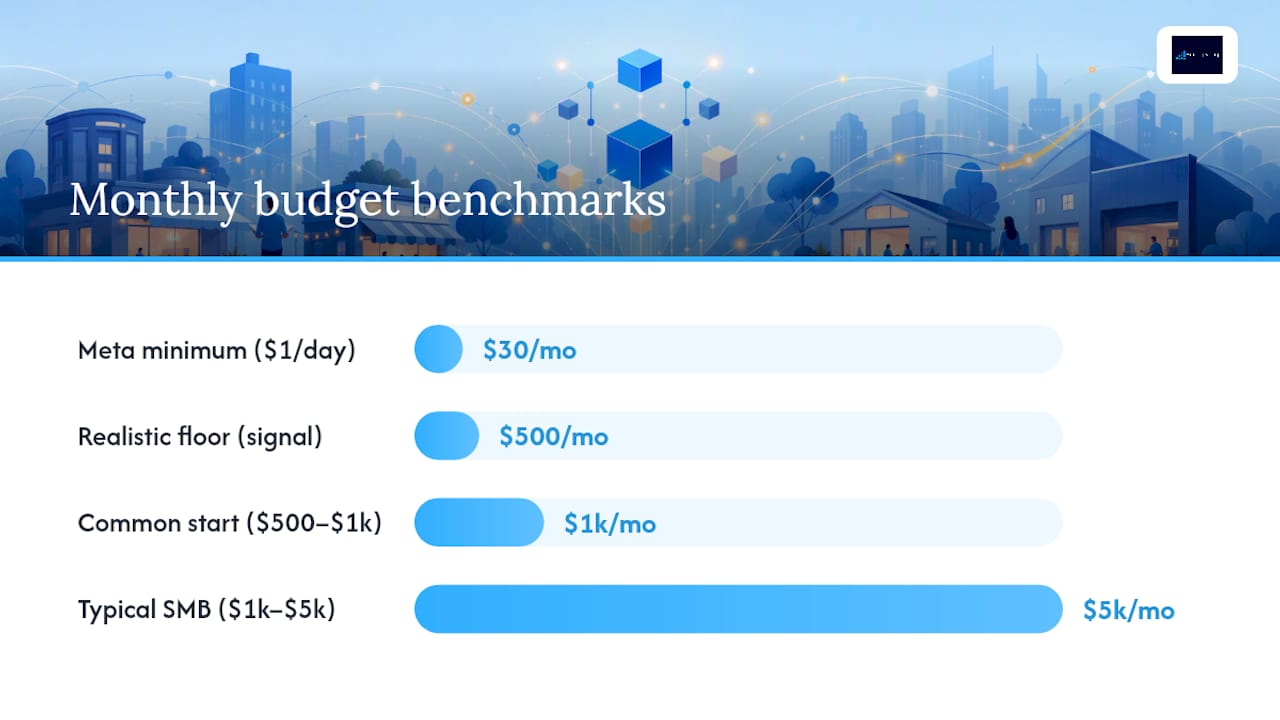
That local service number lines up closely with what most small businesses actually budget, which tends to fall between $1,000 and $5,000 a month, with $500 to $1,000 as a common starting test range. A $1-a-day budget is technically possible to launch, but it rarely generates enough events for Meta’s algorithm to learn who converts. Meta’s own delivery system needs roughly 50 optimization events per week to exit the learning phase and stabilize costs, and a dollar a day almost never gets you there.
$500 a month is the realistic workable floor for most service businesses that want signal within four to six weeks, not just impressions.
Facebook Ads Cost by Industry and Campaign Goal
Benchmarks flatten out real differences between industries, and those differences are large enough to change your entire budget conversation. Finance, insurance, and legal services post the highest CPMs and CPCs on the platform, often two to three times the platform median, because those industries compete for high-value customers with long sales cycles and fierce bidding. Apparel and food brands sit well below the median, often because purchase decisions are impulsive and cheap to trigger.
Rough ranges for common US verticals:
Objective changes the math within any of those verticals. The cheaper click is not the cheaper outcome.
Placement follows the same logic. A low CPM placement like Marketplace or Audience Network can look attractive on a report, but if it converts at a fraction of the rate of Feed placements, the true cost per sale ends up higher despite the lower sticker price per impression.
Testing and Scaling Without Blowing Up Your Costs
That allocation mirrors what a $500 starter test typically looks like in practice, and it protects you from over-investing in retargeting pools that are too small to spend meaningfully anyway.
Pro Tip: Turn on Conversions API before you scale anything. It closes the gap between what actually happened and what the ad platform can see, which is where a lot of “rising CPA” turns out to be a measurement problem, not a performance one. Keep blended attribution in the reporting and that ROAS number stays honest as spend grows.
The One Budget Habit That Actually Matters
Every SMB owner asks “how much should I spend?” The better question is “how do I know when to spend more?” Run the goal-based math from the budget-sizing section above before you touch your daily budget. Then commit to one rule: never increase spend without proof the current spend is already working.
Sources
Frequently Asked Questions
Is $10 a Day Enough for Facebook Ads?
Ten dollars a day can launch a campaign, but it rarely generates enough weekly events to stabilize the learning phase, so expect noisy, unreliable cost data rather than a fair test of performance.
How Much Does 1,000 Views Cost on Facebook Ads?
The 2026 median CPM sits near $14 per 1,000 impressions, though the actual cost for your account depends heavily on your industry, audience size, and creative quality.
Is It Worth Paying for Ads on Facebook?
For most small businesses, yes, but only when the budget is sized against a real allowable cost per acquisition. A $38 median CPA only makes sense if your margin per sale comfortably clears that number.
Is $500 Enough for Facebook Ads?
Five hundred dollars a month is a realistic floor to start testing creative and audiences, and it matches what many small businesses use as a starting test range, though $1,000 to $5,000 a month is more typical once a campaign proves itself.
Share This Article
Found this useful? Send it to another owner who is still guessing at a Meta budget.
Share on Facebook · Share on X · Share on LinkedIn · Share on Pinterest
Want More Information? Let’s Talk.
If you would rather not take this on yourself, we handle it for you. Our Facebook Advertising service takes care of the setup and the ongoing work, then reports back so you can see exactly what changed. You keep running your business; we keep this moving.
Call us at 631-825-9464 or reach out here. No pressure, no obligation, and you can ask us anything — including whether this is even worth doing for a business your size.
Looking ahead, request your free roadmap analysis and we will map out a 12-month plan to close the conversion leaky bucket so more of the customers you already reach turn into booked work.
Written by Joe Leineke · Content on this blog is generated with AI assistance and independently reviewed and fact-checked by human marketing professionals for accuracy and quality.