Google Business Profile optimization is the highest-impact lever for local SEO for plumbers, followed by review generation and citation consistency. Fix those three and most plumbers see measurable movement in calls within 3 to 6 months. The proof points to track: profile completeness, a review count in the 40 to 80 range, and consistent NAP data across every listing.
TL;DR:
Most plumbers see ranking improvements within 3 to 6 months by fully optimizing their Google Business Profile, generating reviews, and maintaining citation consistency. Completing and verifying the GBP, accurately categorizing services, and regularly updating attributes and Q&A sections are essential for local SEO success. Building dedicated service and city pages, ensuring fast mobile page load times, and linking them to the site significantly boost local rankings. Maintaining consistent NAP data across high-value directories and actively managing reviews are critical to prevent ranking drops caused by conflicting listings. Sequentially fixing the profile, reviews, and citations provides a strong foundation, with content and social media as amplifiers rather than initial priorities.
What’s the Fastest Path to Ranking a Plumbing Business Locally?
Ranking locally isn’t complicated, but it is sequential; leveraging AI for SEO can speed content production and optimization for service area pages. Skip steps and you stall out with a half-finished Google Business Profile and three reviews from your cousin. Here’s the order that actually works, broken into a 30/60/90 day plan.
First 30 days:
- Claim and fully verify your Google Business Profile, correcting your service area and hours.
- Audit your name, address, and phone number (NAP) across your top 10 listings and fix mismatches.
- Set accurate emergency hours and after-hours call routing if you offer 24/7 service.
- Build 3 to 6 dedicated service area pages (drain cleaning, water heater repair, emergency plumbing) for your top cities.
- Launch a review request workflow that texts customers within hours of job completion.
- Start local link outreach: sponsorships, supplier pages, and chamber memberships.
- Set up call tracking and review your KPI dashboard monthly.
- Claim and verify correctly. If you work from a truck and don’t take walk-ins, mark your business as a service-area business and hide your street address. Storefront plumbers with a public office should verify as a standard local business.
- Set your primary category to “Plumber.” Add secondary categories only if they’re accurate, such as “Drainage service” or “Water damage restoration service.” Don’t stack categories that don’t reflect real work.
- Fill out every service line item. List each service you offer, not a vague summary. Google matches searches like “sump pump installation near me” against these fields directly.
- Add attributes that matter. “Open 24 hours,” “veteran-owned,” “identifies as women-owned” all help you match niche searches and build trust signals in the Local Pack.
- Write a real business description, upload recent job photos (not stock trucks), and post weekly updates about seasonal services or promotions.
- Pre-fill your own Q&A section. Answer the questions customers actually ask (“Do you charge for estimates?”) before a stranger posts something inaccurate.
- Turn on GBP messaging and check your Insights dashboard weekly to see how customers are finding and contacting you.
- Local proof (a job photo or a review from that specific city)
- A visible price range, even a rough one
- A click-to-call button above the fold
- “St.” versus “Street” or “Ave” versus “Avenue” abbreviation mismatches
- Missing or inconsistent suite/unit numbers
- Old phone numbers from a previous call-tracking setup
- Business name variations (“Smith Plumbing” vs “Smith Plumbing LLC”)
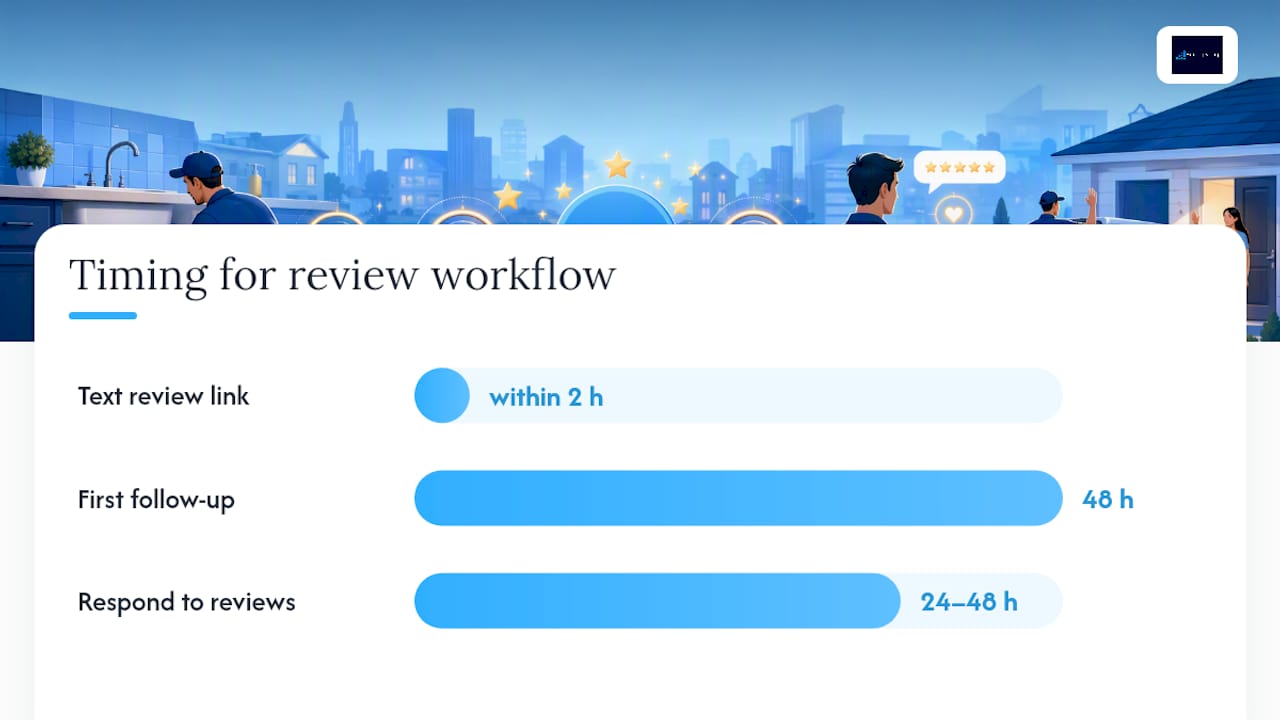
- Text the review link within two hours of job completion, while the fixed leak or the installed water heater is still top of mind.
- Train technicians on a short verbal ask, something as simple as, “If you were happy with the work today, a quick Google review helps us a lot.”
- Follow up once, 48 hours later, if no review has come in. Don’t send a third reminder.
- Respond to every review within 24 to 48 hours, positive or negative, using the customer’s first name and a specific detail from the job.
- Sponsor a local youth sports team or community event for a homepage mention and a backlink.
- Get listed on supplier or manufacturer “find a contractor” pages if you carry their products.
- Build relationships with property managers and real estate agents who need a reliable plumber for turnovers and inspections.
- Ask satisfied commercial clients for a short case study or testimonial you can host on a dedicated page, then request they link to it.
- Review GBP Insights for call and direction-request trends.
- Confirm review velocity is on pace (new reviews added, not just total count).
- Spot-check 5 to 10 citations for new inconsistencies.
- Identify which service pages are driving the most calls and which keywords are bringing in traffic.
- Post short videos explaining common issues (why your water heater is leaking, what a running toilet costs you monthly).
- Share seasonal reminders (frozen pipe prevention in January, sump pump checks before spring rain).
- Respond to every comment and message, even simple ones, since responsiveness shows up in a platform’s own engagement signals.
- Join local Facebook community groups and answer plumbing questions genuinely, without a hard sales pitch attached.
- Google small business bulletin (GBP tips)
- Michigan Tech University — SEO guidance
- Yelp
Days 30 to 60:
Days 60 to 90 and beyond:
How Do You Claim and Optimize a Google Business Profile for Plumbing?
Your Google Business Profile is the single biggest lever in local SEO for plumbers, and most owners leave half of it blank. A complete profile with regular activity outperforms a bare-bones listing almost every time, regardless of how old the business is.
Here’s the build-out, in order:
Google’s own guidance on posts, verification, and messaging features confirms these levers are built specifically to surface active, complete profiles over dormant ones, according to a recent Google small business bulletin. Pre-populated Q&A and service-specific posts also feed Google’s AI overviews, which matters more every quarter as voice and AI-driven search grow.
Pro Tip: Match every GBP service line item to an actual page on your website. A mismatch between what your profile lists and what your site covers creates a relevance gap that quietly suppresses your Map Pack ranking.
What Website Changes Actually Help Plumbers Rank?
Your website needs to do two things at once: tell Google exactly what you do and where, and convert the visitor who’s already decided to call someone. Most plumber websites do neither well.
Build a service plus city page model. Every core service (drain cleaning, water heater repair, sewer line replacement) needs its own page for every city you serve. Each page should include:
Title tags should follow a tight formula: “Emergency Plumber in [City] | 24/7 Service | [Company Name].” Your H1 should mirror that intent without stuffing keywords, and every city page should link back to a central “Service Areas” hub.
Add `LocalBusiness` or `PlumbingService` schema, plus `openingHoursSpecification` markup so Google can confirm your hours match what’s on GBP. FAQ schema on service pages helps you show up in expanded snippets. Michigan Tech University’s SEO guidance confirms mobile-first design and correct schema.org usage are foundational, not optional, for local ranking.
Fast page load times are essential, especially on mobile devices. A slow mobile page loses the exact customer with a burst pipe who won’t wait. Pair fast load times with sticky click-to-call buttons and you convert far more of your existing traffic without spending another dollar on ads. EngageZing’s website design work is built around exactly this mobile speed and conversion standard.
How Do You Fix Inconsistent Business Listings?
An inconsistent NAP (name, address, phone) across directories confuses Google about which listing is authoritative, and that confusion caps your ranking regardless of how good your GBP looks. This is one of the most overlooked pieces of local search for plumbers, mostly because it’s tedious, not because it’s hard.
Run a manual audit of your top 15 to 20 listings first. Look specifically for:
Priority directories for plumbers include Yelp, YellowPages, Angi, the Better Business Bureau, and your local chamber of commerce. These sites carry weight specifically because they’re recognized as high-value citation sources for trade businesses, and Google cross-references them when confirming your business details.
For fewer than 20 listings, fix them manually. Once you’re managing 50 or more across multiple locations, a tool like BrightLocal or Whitespark saves hours and flags new mismatches automatically. Either way, re-audit quarterly. Directories change formatting, get scraped incorrectly, or duplicate old listings without warning. EngageZing’s business listings and voice search management handles this cleanup and ongoing monitoring for owners who don’t want to chase down 40 directories by hand.
How Many Reviews Does a Plumber Need to Rank Well?
Review count, velocity, and recency directly influence Local Pack placement, and plumbing businesses with 40 to 80 reviews collected steadily outperform competitors who have more total reviews but no recent activity. Aim to add 4 to 8 new reviews a month. Rating matters too: going from 4.2 to 4.6 stars is worth real calls, because homeowners comparing three plumbers on a map screen read the star average before they read anything else.
Build the ask into your workflow instead of hoping customers remember:
Negative reviews need a calm, factual response, not a defensive one. Acknowledge the issue, state what you did or will do about it, and move the conversation offline with a phone number. Only request removal through Google’s process when the review violates policy (fake, posted by a non-customer, or contains abusive language) rather than because it’s simply unflattering.
Pro Tip: A short, specific response to a negative review often does more for conversion than ten glowing five-star reviews. Prospective customers read the response as much as the complaint. EngageZing’s review generation and reputation management service automates the ask and flags reviews that need a fast response.
Which Local Partnerships Actually Move the Needle?
Local links tell Google your business is a real, established part of the community, not just a website that exists. Even a handful of strong local links can accelerate movement in the Local Pack when your GBP and citations are already solid.
Tactics worth your time:
Sponsorship and directory links tend to help Maps ranking most, since they reinforce local relevance signals. Guest content or a detailed case study picked up by a local news outlet or trade blog does more for organic authority beyond the Map Pack. Pursue both, but don’t confuse one for the other when you’re measuring results.
How Do You Track Whether Local SEO Is Working?
Set a monthly rhythm and stick to it. The KPIs that matter for plumbers are GBP calls, website calls, booked jobs, map clicks, and profile views, tracked separately so you know which channel is actually producing.
Set up call tracking with unique phone numbers for GBP, your website, and any paid ads, so you can separate Maps leads from organic and paid leads. Without that split, you’re guessing.
Monthly checklist:
EngageZing’s Local Service Ads setup pairs well with this tracking model when you want paid visibility layered on top of organic gains during slower ranking months.
How Does EngageZing Approach Local SEO for Plumbers?
The process starts with cleanup, not content. GBP corrections come first, since a messy profile undermines every other tactic. Citation fixes follow, then a review generation system, then service-area page builds, then tracking, and finally Local Service Ads if the market calls for faster visibility.
A plumber with three trucks and one call center doesn’t need the same 12-month content plan as a five-location regional company. The deliverables should match the size of the operation, not a generic package.
EngageZing positions its pay-per-result SEO model, review generation automation, and AI-driven operations tools as options within that process, not guarantees of a specific ranking outcome. A solo plumber with time and patience can DIY most of this over a few months. An owner running multiple trucks with no time for GBP audits or review follow-up is usually better served handing the cleanup and tracking to a team that does it daily. Initial deliverables from an agency engagement should include a GBP audit, a citation report, and a review workflow set up within the first two to three weeks.
Does Social Media Actually Help a Plumber’s Local Rankings?
Social media doesn’t move your Google ranking directly, but it builds the brand signals and referral traffic that support everything else you’re doing. A plumber who posts job photos, storm-prep tips, and quick before/after videos on Facebook and Instagram stays visible to past customers who search your name directly later, which itself is a ranking signal Google notices.
Focus on Facebook first for most plumbing businesses, since local homeowners in the 35 to 65 age range still use it heavily for neighborhood recommendations and local group posts. Instagram works well for visual before/after content, especially bathroom remodels or fixture upgrades. Skip platforms that don’t match your customer base just to say you’re “active everywhere.”
Practical moves that work:
Consistency beats frequency here. Three solid posts a week for a year outperforms a burst of daily posts for two weeks followed by silence.
How Should Plumbers Optimize for Voice Search?
Voice queries skew conversational and urgent: “who’s a plumber near me open right now” or “how much does it cost to fix a leaking pipe.” Optimizing for these means writing content the way customers actually talk, not the way you’d write a title tag.
FAQ sections on your service pages should answer real spoken questions directly, in full sentences, since voice assistants pull answers from clear, direct text rather than fragmented bullet phrases. “How much does emergency plumbing cost in [city]?” followed by a two-sentence answer with a real price range performs better for voice than a vague paragraph about your company’s values.
Your GBP hours and attributes need to be airtight, because voice search leans hard on structured data to answer “open now” and “near me” queries. A mismatch between your listed hours and your actual hours doesn’t just annoy a caller. It causes the assistant to skip you for a competitor with cleaner data.
Local, natural phrasing matters more than keyword density for voice. Write your service descriptions the way you’d explain the job over the phone, and use the neighborhood or city name naturally rather than forcing it into every sentence. Schema markup, particularly FAQ and LocalBusiness schema, gives voice assistants a clean, structured source to pull from instead of guessing at your page’s intent.
What Seasonal Tactics Work Best for Plumbing SEO?
Plumbing demand swings hard by season, and your GBP posts, ads, and service pages should swing with it instead of staying static year round.
Winter is frozen pipe and no-heat-emergency season. Post proactively about pipe insulation and space heater safety in late fall, then shift GBP posts to “24/7 emergency service” messaging once temperatures drop. Spring brings sump pump failures and water heater replacements after a hard winter; this is the window for maintenance-plan promotions. Summer shifts toward irrigation, outdoor fixture work, and AC-adjacent plumbing (condensate lines). Fall is prep season: winterization services, gutter and drain checks before the next freeze.
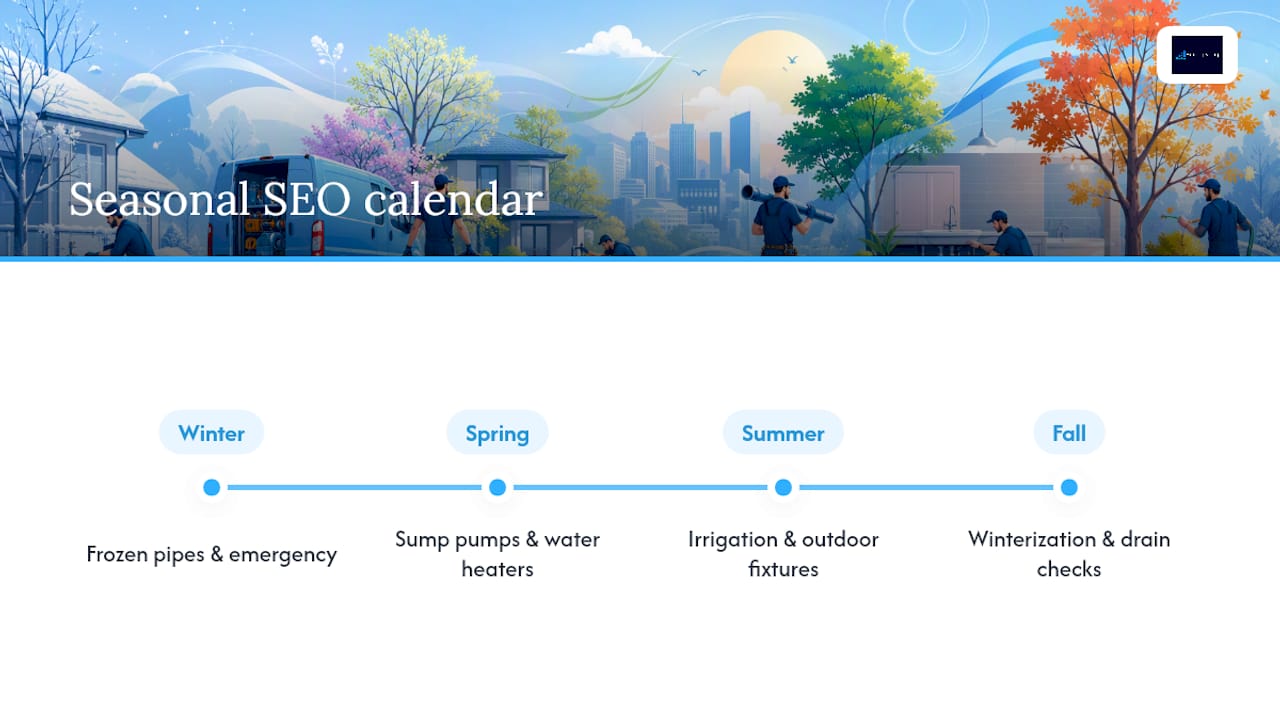
Update your GBP posts monthly to match whatever season is actually driving calls in your market, and build a simple promotional calendar so you’re not scrambling to write a post the week of the first freeze warning. A modest seasonal discount (“$25 off drain cleaning through October”) posted directly to GBP and pinned to your homepage captures searchers comparing multiple plumbers in the moment.
Track which seasonal pages and posts actually generate calls year over year, then double down on what worked and drop what didn’t. Seasonal content compounds: a well-built “frozen pipe repair” page keeps ranking every winter with almost no extra work once it’s live.
The Playbook Works, But Sequence Beats Speed
Most plumbers who fail at local SEO don’t fail from lack of effort. They fail from doing everything at once, badly, instead of doing three things well in order. A half-finished GBP profile, twelve reviews from six months ago, and a homepage with no service pages will not outrank a competitor who nailed the fundamentals first.
The conventional advice oversells content volume and undersells consistency. A plumber does not need fifty blog posts. A plumber needs a complete GBP, a review count that climbs every month, and NAP data that matches everywhere it appears. Everything else, including social media and seasonal campaigns, is a multiplier on a foundation that either exists or doesn’t.
If you take one thing from this playbook, take the order: profile first, reviews second, citations and service pages third. Owners who reverse that order and chase link-building or paid ads before fixing the basics tend to waste budget propping up a weak foundation instead of building on a strong one.
Sources
Frequently Asked Questions
How much should I pay for local SEO?
Costs vary widely by market and provider, ranging from a few hundred dollars monthly for basic citation management to several thousand for full-service SEO with content and link building. Pay-per-result models, like the one EngageZing offers, tie cost more directly to actual ranking and call improvements rather than a flat retainer.
Who should I contact for plumbing SEO help in the United States?
Look for an agency with specific local SEO experience in the trades, not a generalist marketing firm. EngageZing offers local account management and services built specifically around plumbing and other service-based businesses.
What is the best way to advertise as a plumber?
A combination of an optimized Google Business Profile, Local Service Ads, and word-of-mouth driven by strong reviews outperforms any single channel alone. Emergency and seasonal searches respond especially well to Local Service Ads paired with a well-built service page underneath.
Share This Article
Found this useful? Send it to another owner who is still running three trucks and no listing strategy.
Share on Facebook · Share on X · Share on LinkedIn · Share on Pinterest
Want More Information? Let’s Talk.
If you would rather not take this on yourself, we handle it for you. Our Near-Me Search Boost service takes care of the setup and the ongoing work, then reports back so you can see exactly what changed. You keep running your business; we keep this moving.
Call us at 631-825-9464 or reach out here. No pressure, no obligation, and you can ask us anything, including whether this is even worth doing for a business your size.
Looking ahead, request your free roadmap analysis and we will map out a 12-month plan so more of the customers you already reach turn into booked work.
Written by Joe Leineke · Content on this blog is generated with AI assistance and independently reviewed and fact-checked by human marketing professionals for accuracy and quality.