Scalable Multi Location SEO for Brands: Master Data, GBP, Reviews
Verify a Google Business Profile for every physical storefront, publish one canonical location page per address, and keep NAP details identical everywhere they appear. Layer in a steady review program per location, and you’ve built the foundation that moves rankings. Most brands see local-pack movement within a few months of sustained, consistent activity, not overnight.
TL;DR:
Verifying every Google Business Profile and linking it to location-specific pages is essential to maximize local-pack visibility, especially when managing many storefronts. Location pages should contain at least 300 words of unique, locally relevant content, with optimized schema markup and authentic photos to avoid being filtered as doorway pages. Consistent NAP details across key directories and extracting reviews at a rate of at least two per month per location significantly strengthen local trust signals and rankings. Managing citations at scale requires auditing primary data sources, correcting mismatches, and using citation management platforms for efficiency as the business grows beyond a few locations. Focusing effort on high-revenue and highly competitive markets yields the greatest impact, with the initial priority being verification, data parity, and review velocity for each storefront.
What Does Multi-Location SEO Actually Require?
Multi-location SEO needs its own playbook because a single-location tactic breaks the moment you add a second address. What works for one storefront (a solid homepage, one Google Business Profile, a handful of citations) turns into a liability at scale if every location shares the same thin content or conflicting phone numbers. Google evaluates each location as a separate entity, which means duplicated effort isn’t a shortcut. It’s a penalty waiting to happen.
Six pillars hold up a functioning multi-location program, and the Foragentis six-pillar framework confirms location pages and Google Business Profile management carry the most operational weight of the six:
- Location pages — one unique, canonical page per physical address
- GBP network management — verification, categories, and consistent linking across every profile
- Citations and NAP consistency — matching name, address, and phone across every directory
- Review generation — steady monthly velocity per storefront, not just high totals
- Site architecture — a URL structure that avoids cannibalization
- Measurement and scale — KPIs and a repeatable rollout process
If you’re managing five locations or fifty, three fixes deliver outsized results inside a 30 to 90 day window. First, verify any Google Business Profile still sitting in “pending” or unclaimed status. Second, audit and correct your top 10 NAP mismatches per location across the directories that matter most. Third, set a firm target of at least a couple of new reviews per month per location and put location-specific review links in front of customers.
The most common failure isn’t neglect. It’s templated location pages that swap out a city name and phone number while leaving everything else identical. That dilutes the very authority you’re trying to build, and it’s the single fastest way to have your location pages ignored, or worse, filtered out as doorway pages.
What Should Every Location Page Include?
Each location page needs to read like it was written by someone who has actually walked into that storefront. Google’s own multi-location SEO guidance treats generic, duplicated location content as a doorway-page risk, and that risk is entirely avoidable with the right structure.
Start with the URL pattern. A subfolder structure like `yourdomain.com/locations/city-name/` keeps everything under one root domain, which preserves the authority you’ve already built rather than splitting it across separate URLs. Canonicalize each page to itself, never to a hub page, so search engines index every location independently.
Every page on your network should include these elements without exception:
- An H1 that names the city and the core service (e.g., “Emergency Plumbing in Denver”)
- Full NAP details matching your Google Business Profile exactly
- Hours of operation, including holiday exceptions
- Geo-coordinates and an embedded map
- Driving directions from major nearby landmarks
- Original photos of that specific location, staff, and storefront
- Staff bios for that location’s team
- Testimonials or review excerpts from customers at that address
- 300 to 800+ words of unique content covering local specifics: parking, neighborhood landmarks, service-area nuances, or community involvement
| Element | Minimum requirement | Common mistake |
|—|—|—|
| Unique word count | 300–800+ words | Copy-pasted boilerplate with city name swapped |
| Schema markup | LocalBusiness with sameAs to GBP | Missing schema or shared across pages |
| Photos | Location-specific, unedited stock swaps | Reused corporate stock photography |
| Testimonials | Location-tagged reviews only | Mixed reviews from unrelated stores |
| NAP | Exact match to GBP and citations | Suite number or phone format mismatch |
LocalBusiness schema needs to include your business name, address, phone, hours, geo-coordinates, and a `sameAs` link pointing directly to that location’s Google Business Profile. That `sameAs` connection is what tells Google’s entity-matching systems that the page and the profile represent the same real-world place, which reduces the chance either gets treated as duplicate or low-trust content.
How Do You Manage Google Business Profiles at Scale?
Every physical storefront needs its own verified Google Business Profile. That’s not optional, and it’s the single fastest lever for local-pack visibility across a multi-location network. Bulk verification through Google’s location group tools works for most storefronts, but Google requires manual video or postcard verification for newly opened locations, businesses in certain regulated categories, or profiles flagged for suspicious activity.
Category selection matters more than most operators realize. Choose the primary category that most precisely matches your core service, then layer in two or three secondary categories that capture adjacent services customers search for. Attributes deserve the same attention: accessibility features, accepted payment types, and specific services offered all feed into how Google matches your profile to a searcher’s query.
Pro Tip: Audit your GBP website field across every location. If even 10% of your profiles link to the homepage instead of their specific canonical location page, you’re actively working against your own local-pack rankings. Practitioner testing shows misaligned GBP links can suppress rankings that correctly aligned links would otherwise support.
Run through this checklist across your network:
- Confirm every GBP status shows “verified,” not “pending”
- Set primary category first, then add relevant secondary categories
- Select every applicable attribute (accessibility, payment, service options)
- Point the website field to the exact canonical location page URL
- Post updates at least weekly with location-specific photos and offers
Posting cadence sounds minor, but profiles with regular activity and fresh photos tend to hold local-pack position more consistently than dormant ones. A weekly post with real photos from that specific storefront beats a monthly corporate graphic every time.
How Do You Fix NAP Consistency Across Every Location?
Citation inconsistency is quiet damage. No single wrong phone number tanks a location overnight, but dozens of small mismatches across directories erode the trust signals Google uses to confirm your business is real and stable. Fixing it follows a clear sequence:
- Gather your top 20 directories per location. Start with Google Business Profile, Bing Places, Apple Maps, Yelp, and the major data aggregators, then add industry-specific directories relevant to your category.
- Check formatting against your master record. Suite numbers, abbreviations (“St.” vs. “Street”), and phone formatting all need to match exactly, not just approximately.
- Find and flag duplicate listings. Duplicate profiles for the same address split review signals and confuse the entity-matching process Google relies on.
- Track propagation timing. Corrections at primary data sources like Google and the major aggregators can take several weeks to ripple through secondary directories.
- Location-specific review links, generated separately for each address, so feedback lands on the correct GBP
- QR codes at checkout counters or on receipts, pointing straight to that location’s review link
- Automated post-service email or SMS requests sent within 24 hours of a completed transaction
- Direct prompts from staff at the point of service, which consistently outperform passive signage
- Homepage → `/locations/` hub → individual location pages
- Each location page → 2 to 3 nearby locations (geographic proximity, not alphabetical)
- Each location page → relevant service pages for that specific address
- Service-location pages (e.g., `/locations/denver/emergency-repair/`) only when that combination has genuinely distinct local content to justify a standalone page
- Neighborhood or service-area pages tied to real geographic detail
- Localized case studies featuring that specific location’s customers
- Location-specific FAQs addressing questions unique to that market
- Event or seasonal pages tied to that storefront’s actual activity
- Staff profiles with names, roles, and photos from that specific team
- Build the master repo before touching citation platforms or bulk GBP tools
- Adopt automation (citation management, bulk GBP edits) once you’re past roughly 15 to 20 locations
- Assign a content owner responsible for location page quality
- Assign a location manager responsible for local reviews and GBP posts
- Keep a central operations role owning the master repo and reporting cadence
- Google Business Profile verification help covers the exact verification requirements and options by business category
- Search Engine Land’s multi-location SEO guide details schema requirements and doorway-page avoidance
- Search Engine Journal’s complete guide to local SEO for multiple locations backs the review velocity and citation consistency guidance throughout this playbook
- Foragentis’s six-pillar framework research provides the operational structure behind prioritization and scaling decisions
- Google Business Profile help — Verify your business
- The Complete Guide To Local SEO For Multiple Locations
- Multi-Location SEO in 2026: A Six-Pillar Framework Backed by SERP Data · Foragentis
For remediation, correct the primary sources first: Google Business Profile, then the data aggregators that feed hundreds of smaller directories automatically. Submit suppression requests for duplicates you can’t merge directly. Once you’re managing 20 or more locations, manual correction becomes impractical, and a citation platform like Yext or Uberall starts to pay for itself in time saved. Choose a platform based on three criteria: how many directories it actually covers, how fast corrections propagate, and how well it integrates directly with your Google Business Profile network. Managed business listings and voice search services can also handle this layer if you’d rather not run the audit in-house.
How Many Reviews Does Each Location Need Per Month?
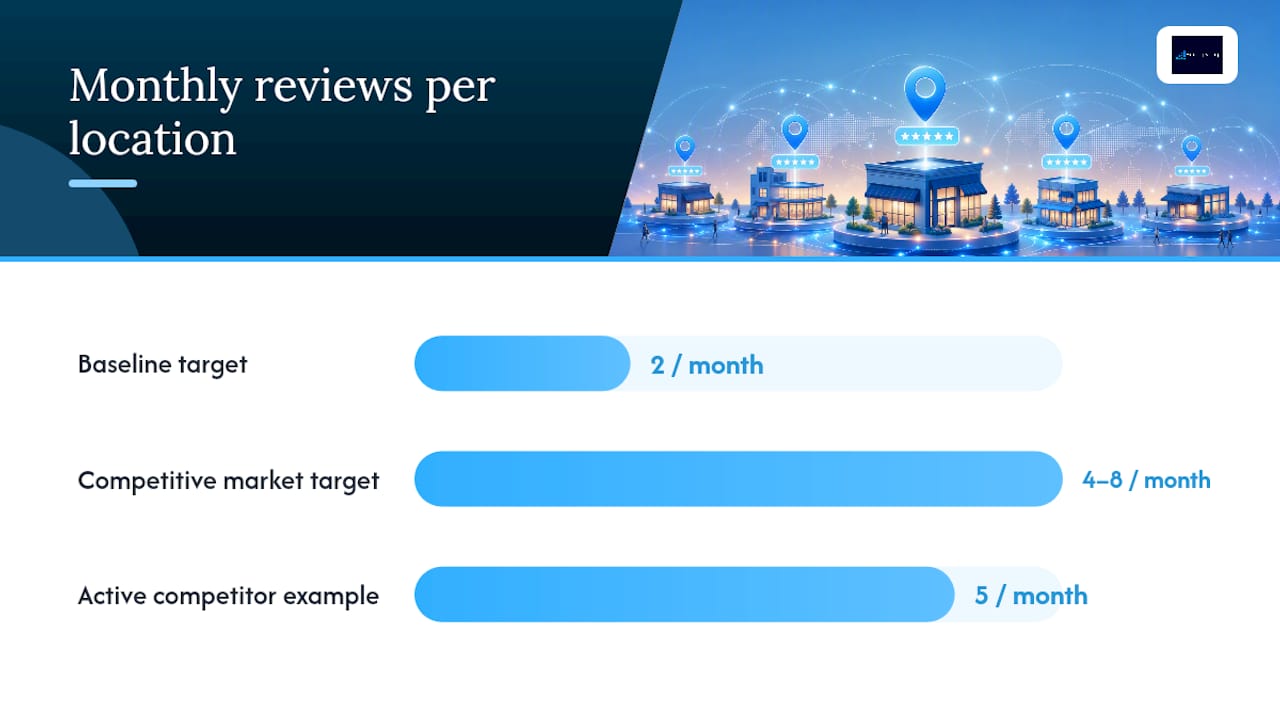
Set a floor of two new reviews per month for every location, and push that to four to eight per month in competitive markets where every nearby competitor is also actively collecting reviews. Review recency and velocity function as a stronger short-term ranking signal than your historical total, according to Search Engine Journal’s multi-location analysis, which means a location with 40 reviews and none in the past six months can lose ground to a newer competitor collecting five reviews a month.
The tactics that actually move that number:
Pro Tip: Track your response rate as closely as your review count. Aim to respond to every negative review within 48 hours, acknowledging the issue specifically rather than with a generic apology. A fast, specific response often does more for a hesitant customer reading it later than the original review did.
Managed review generation and reputation services exist precisely because doing this manually across a dozen locations eats an operations team’s week fast.
Should You Use Subfolders or Separate Domains for Locations?
One domain with a `/locations/` subfolder structure is the right default for nearly every multi-location business. Splitting locations across separate domains fragments the domain authority you’re trying to build and forces you to earn trust signals from zero, repeatedly, for every new market you enter.
The internal linking pattern should follow a clear hierarchy: homepage links to your `/locations/` hub, the hub links to every individual location page, and each location page links back up to the hub plus sideways to nearby locations and relevant service pages. Every internal link should point to the canonical version of a page, never to a duplicate or a parameter-variant URL.
That last point is where doorway risk creeps back in. Publishing a service-location page for every service and city combination, regardless of whether there’s anything unique to say, creates dozens of thin pages that dilute your site’s overall authority instead of building it.
What Local Content Actually Moves Rankings?
Not all local content earns its keep. Neighborhood-specific pages, localized case studies, location-tagged FAQs, event pages tied to a specific store, and individual staff profiles all provide genuine local signals that a generic corporate blog post never will.
The allocation that works in practice: aim for 30% to 50% unique local content on your highest-priority location pages, and centralize broader topics (industry trends, company news, general how-to guides) on your main blog or resource hub. Duplicating that broad content across every location page splits your internal link equity and actively reduces local rankings, according to practitioner analysis of multi-location sites.
AI-driven search raises the stakes here. Search systems increasingly rely on structured local facts and schema accuracy to decide which location page gets surfaced in an AI Overview or a voice response, and templated pages without distinct local signals simply don’t get picked.
What Metrics Should You Track Per Location?
Six numbers tell you whether a location page and its Google Business Profile are working: local-pack rank, GBP impressions, GBP actions (calls, direction requests, website clicks), organic visits to the location page itself, review velocity, and a citation accuracy score across your top directories.
| Metric | What it tells you | Target cadence |
|—|—|—|
| Local-pack rank | Visibility for core local queries | Weekly check |
| GBP impressions | Search and Maps visibility | Monthly review |
| GBP actions | Calls, directions, site clicks | Monthly review |
| Organic visits to location page | Site-level local SEO health | Monthly review |
| Review velocity | Fresh trust signals | 2+ per month minimum |
| Citation accuracy score | NAP consistency across directories | Quarterly audit |
Use this data to prioritize, not just to report. Rank locations by revenue potential, local competitive intensity, and current performance gaps, then put your team’s limited hours against the weakest-performing, highest-potential markets first rather than spreading effort evenly across every storefront.
How Do You Operate Multi-Location SEO at Scale?
Once you’re past a handful of locations, spreadsheets and memory stop working. You need a master data repository holding the fields that feed everything downstream: business name, address, phone, hours, geo-coordinates, GBP profile ID, canonical page URL, and the local manager’s contact information. That single source of truth is what a six-pillar operational framework points to as the difference between a program that scales cleanly and one that drifts into inconsistency location by location.
Prioritize rollout and maintenance work using three factors: revenue potential of the market, competitive intensity in that local-pack, and how far the location currently sits below your best-performing stores.
What I’d Fix First on Any Multi-Location Audit
Every audit I run starts in the same place: confirm every Google Business Profile is actually verified, then check whether each profile’s website link points to its correct canonical location page. That single misalignment, a GBP pointing to the homepage instead of its own city page, quietly caps how high that location can rank no matter how good the on-page content is. Fixing it is often the fastest visible win in the entire program.
Beyond that first fix, the mantra I’d hand any team managing more than a handful of storefronts is simple: fix data parity, build review velocity, and prioritize markets by impact. Everything else in this playbook is detail work in service of those three moves.
Get a Free Analysis of Your Location Network
A managed service is a direct alternative to hiring an in-house team to manage this playbook location by location. Instead of your staff manually auditing citations, chasing GBP verifications, and requesting reviews across a growing store count, EngageZing runs it as a managed program with local account management built in.
The core services map directly onto what this article covers, including business listings and voice search for citation and NAP management, pay-per-result SEO for ongoing location-page optimization, review generation and reputation management for monthly velocity targets, near-me search boost for GBP and local-pack performance, and local service ads as a paid complement where organic alone isn’t fast enough. If you’re managing more than a few storefronts and want to see exactly where your network is leaking rankings, head to Grow for a free analysis. Or start with Business Listings & Voice Search to see how citation management works location by location.
Where to Go for Primary Documentation
Before rolling out changes across dozens of locations, check implementation details against primary sources rather than relying on secondhand summaries.
Sources
Frequently Asked Questions
Is SEO dead or still evolving?
SEO isn’t dead, it’s shifting toward entity-based and AI-driven search, which raises the value of structured, accurate local data rather than lowering the value of SEO overall.
Do I need a separate Google Business Profile for each location?
Yes. Every physical storefront needs its own verified Google Business Profile because Google evaluates each location as a distinct entity for local-pack rankings.
How many reviews should each location get per month?
Aim for a minimum of a couple of new reviews per month per location, and more frequent reviews if you’re competing in a crowded local market.
Should I use subfolders or separate domains for multiple locations?
Use one domain with `/locations/` subfolders for nearly every multi-location business. It’s the structure that preserves domain authority instead of splitting it across separate sites.
What are the four main types of SEO?
The four commonly recognized types are on-page SEO, off-page SEO (including citations and backlinks), technical SEO, and local SEO, which is the category multi-location strategy falls under.
What is the 80/20 rule as it applies to multi-location SEO?
Roughly 20% of your locations, usually the highest-revenue or highest-competition markets, tend to drive the majority of your program’s impact, which is why prioritizing effort by revenue potential and competitive intensity matters more than spreading work evenly.
Recommended
Share This Article
Found this useful? Send it to another owner who is still running the same playbook location by location.
Share on Facebook · Share on X · Share on LinkedIn · Share on Pinterest
Want More Information? Let’s Talk.
If you would rather not take this on yourself, we handle it for you. Our Business Listings & Voice Search service takes care of the setup and the ongoing work, then reports back so you can see exactly what changed. You keep running your business; we keep this moving.
Call us at 631-825-9464 or reach out here. No pressure, no obligation, and you can ask us anything — including whether this is even worth doing for a business your size.
Looking ahead, request your free roadmap analysis and we will map out a 12-month plan to close the conversion leaky bucket so more of the customers you already reach turn into booked work.
Written by Joe Leineke · Content on this blog is generated with AI assistance and independently reviewed and fact-checked by human marketing professionals for accuracy and quality.