Audit First: Fix Tier 1 Local Citations for Small Businesses
A local citation is any online mention of your business name, address, and phone number, whether it links back to your site or not. Consistent citations tell Google your business is real and where it actually operates, which directly affects your map-pack rankings. If you’ve never checked yours, start with an audit today: search your business name and phone number, note every listing, and flag anything that doesn’t match.
TL;DR:
Consistent business NAP data across major platforms and aggregators is essential for improving local map-pack rankings and attracting nearby customers. Audit your existing citations by searching your business name and phone number in quotes on Google and review high-traffic profiles manually for accuracy. Focus on fixing top-tier profiles like Google, Yelp, and Apple first, then update data aggregators before adding relevant niche directories to build local relevance. Ongoing management is crucial because public edits and outdated feeds can reintroduce errors, requiring regular re-checks and standardized formatting practices. Dedicated citation management services treat it as an ongoing operation to maintain visibility rather than a one-time fix, especially for multi-location or competitive markets.
What Is a Local Citation, Exactly?
A local citation is any web mention of your business’s name, address, and phone number, known in the industry as NAP data. Citations come in three forms: structured (a formatted directory listing like a Yelp profile), unstructured (a mention buried in a blog post or news article), and implied (a listing that shows your name and address but skips the phone number, letting context fill the gap).
Citations aren’t backlinks. Many carry no clickable link at all, and their value comes from data consistency rather than authority transfer. They’re also not the same as your Google Business Profile, which is a single, more powerful listing you directly manage. Here’s how the pieces differ:
- NAP fields: name, address, phone, the core three Google cross-checks
- Optional fields: hours, categories, website URL, photos, and short descriptions
- Citations vs. backlinks: citations validate identity, backlinks pass authority
- Citations vs. GBP: GBP is a controlled profile, citations are scattered third-party mentions
Why Do Local Citations Matter for Local SEO?
Consistent NAP data across the web builds Google’s confidence that your business exists at the address you claim, which improves map-pack accuracy for searches near you. Mismatched addresses or old phone numbers create doubt, and doubt shows up as lower visibility in local results.
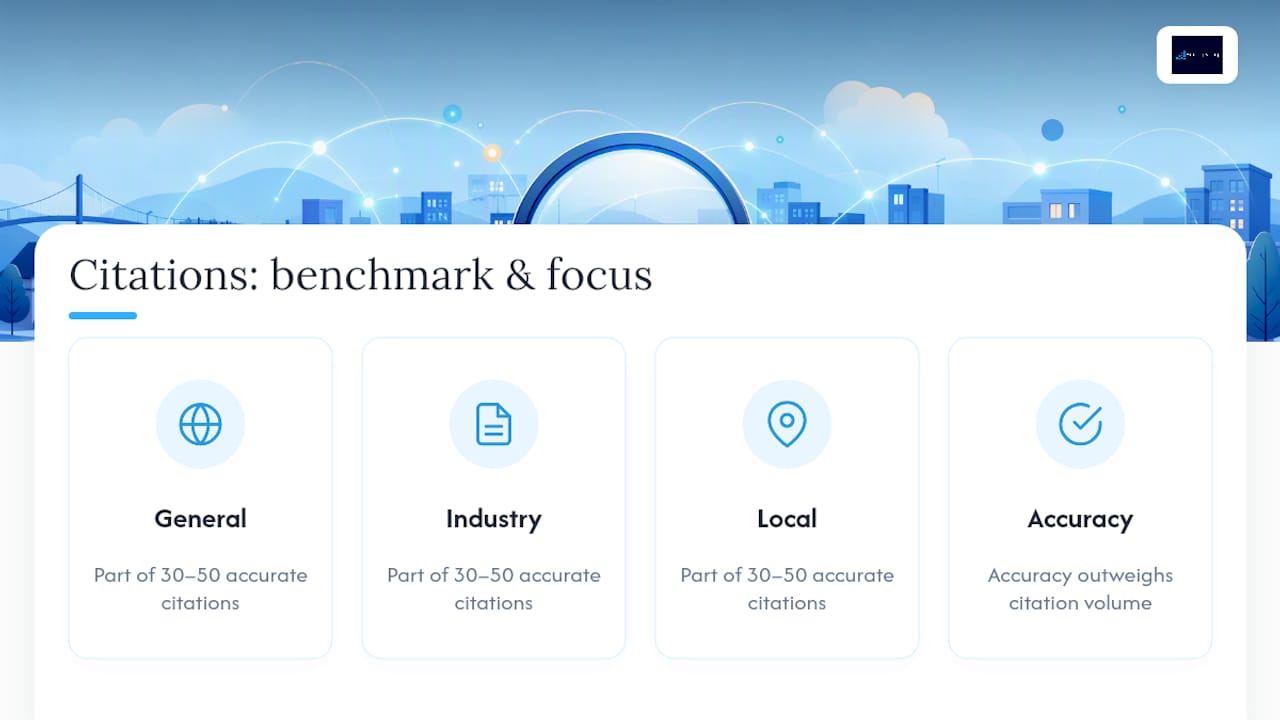
Citations pay off in ways beyond rankings, too. A directory listing often puts you in front of customers who leave reviews, and some directories send direct referral traffic on their own. The suggested benchmark for many small businesses is 30 to 50 accurate citations spread across general, industry, and local platforms, but accuracy always outweighs volume.
Citation cleanup matters most in three situations: you just opened and have no footprint yet, you run multiple locations that multiply your risk of errors, or you compete in a crowded market where every ranking signal counts.
What Types of Citations Should You Know?
Think of citations in tiers. Tier 1 covers major platforms like Google Business Profile and Yelp. Tier 2 covers data aggregators that feed hundreds of smaller sites. Tier 3 covers niche and local directories tied to your industry or city.
- Structured citation: your business listed in a formatted directory profile with clear NAP fields
- Unstructured citation: your address mentioned in a local news article or community blog post
- Implied citation: a directory entry showing your name and address but leaving out the phone number
How Do You Audit Your Existing Citations?
Start by searching your exact business name in quotation marks, then repeat the search with your phone number in quotes. Phone-number searches often surface old listings tied to a former business name or a disconnected number that a name-only search would miss entirely. Check the Tier 1 platforms manually, since automated tools sometimes miss recent edits on these high-traffic sites.
- Search your business name in quotes across Google.
- Search your phone number in quotes, including any old numbers.
- Visit each Tier 1 profile directly and record what you find.
- Log every listing in a spreadsheet: site, URL, current NAP, correct NAP, and status.
- Sort by priority. Fix Tier 1 errors and glaring mismatches first, then chase duplicates.
- Fix your Tier 1 profiles first: Google Business Profile, Bing Places, Apple Business Connect, Facebook, and Yelp.
- Submit corrected NAP data to major data aggregators, since many smaller directories pull straight from these feeds.
- Add niche and local directories relevant to your industry or city, which build topical relevance beyond generic listings.
- Skip mass-listing packages that dump your business into hundreds of low-quality sites with no editorial standards.
- If you hire outside help, insist on shared login access and a full record of every profile created or edited.
- Recheck your Tier 1 profiles and top aggregators every quarter at minimum.
- Assign one person, even part-time, to own citation checks so nothing falls through the cracks.
- Standardize formatting everywhere: pick “St” or “Street” and stick with it, always include suite numbers, and use one consistent phone format.
- Google Business Profile: the single most influential listing for map-pack visibility
- Apple Business Connect: powers listings across Apple Maps and Siri results
- Bing Places: smaller share of search traffic, but still feeds voice assistants and some directories
- Facebook Business: doubles as a citation and a discovery channel for local reviews
- Yelp: heavily weighted in local algorithms and a common data source for other directories
- Local Citation Management | Local SEO – Moz
- How to Build Local Citations & Boost Your Visibility Online | WordStream
- What are local citations in SEO? – Semrush
Automation tools speed up discovery across dozens of smaller directories, but they can’t replace a manual look at your highest-traffic profiles.
Pro Tip: Search your phone number, not just your business name. Legacy listings under an old name or address almost always show up under the number first.
How Do You Build and Prioritize New Citations?
Building citations works best as a sequence, not a shopping spree. A common, efficient path is to audit first, fix Tier 1, cascade through aggregators, then fill in niche directories, because doing it in reverse wastes time correcting the same error five times over.
Quantity chasing is the single most wasted dollar in citation building. A batch of 200 low-quality listings does less for your rankings than 30 accurate ones on directories real customers actually browse.
Why Do Citations Need Ongoing Management?
Citation work doesn’t end once you’ve corrected everything. Some platforms allow public edits or crowdsourced corrections, which means a well-meaning stranger, or a competitor, can quietly change your listed hours or address. Old data feeds also resurface outdated information months after you thought it was fixed.
Pro Tip: If you outsource citation management, require a spreadsheet of every URL touched and shared login credentials for any new profiles. Without that, you lose the ability to fix things yourself later.
Which Sites and Tools Should You Check First?
Start with the platforms that carry the most weight in local search, then work outward.
Beyond these five, major data aggregators like Data Axle, Neustar, and Foursquare distribute your NAP data to dozens of smaller sites automatically, which is why fixing errors at the aggregator level saves you from chasing the same fix fifty times. A niche directory, like a regional chamber of commerce site or an industry-specific listing service, tends to add more value than another generic directory once your Tier 1 and aggregator data are clean.
How Long Does Citation Cleanup Take to Pay Off?
A thorough audit for a single-location business typically takes a few hours of focused work, though directory approvals can take a few days to a few weeks to reflect changes. Ranking benefits from citation cleanup generally show up within six to twelve weeks when paired with other local SEO work like review generation.
DIY citation cleanup costs you time instead of money, while paid services vary widely depending on how many locations and directories are involved. Track map-pack ranking position, GBP calls and direction requests, and referral traffic from directory sites to know if the work is paying off.
What Agency Work Teaches You About Citations
Citation cleanup rarely delivers its full value as a one-time project. At EngageZing, we treat it as ongoing operations, because public edits and stale data feeds keep undoing the fixes you made last quarter. Clients who pair citation correction with review generation and Google Business Profile optimization consistently see faster, more durable gains in local visibility than citation cleanup alone produces.
The businesses that struggle most are the ones treating citations as a “set it and forget it” checkbox. They’re not.
— Joe Leineke
How EngageZing Handles Business Listings for You
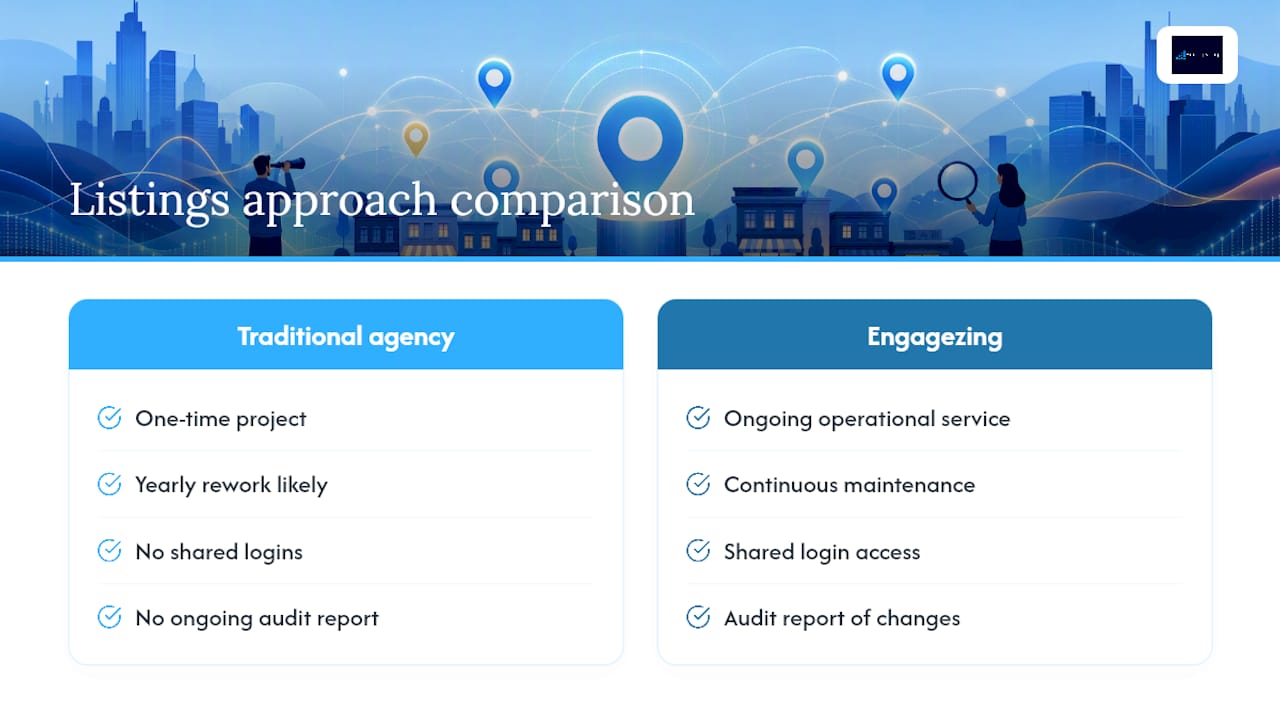
EngageZing is the alternative to a traditional agency for local citation cleanup: instead of a one-time project you’ll need to redo in a year, our Business Listings & Voice Search service treats your NAP data as ongoing operational work, with a local account manager watching for the public edits and duplicate listings that quietly undo your fixes.
Every engagement begins with a free roadmap analysis that maps where your citations, reviews and Google Business Profile stand, then builds a 12-month plan for growth. Once you’re set up, you get shared login access to every profile we touch, an audit report showing what changed and why, and a recurring check-in cadence instead of a single invoice and a goodbye email.
Ready for a clear plan? Start with a roadmap analysis and see exactly where your local listings are losing visibility — plus a 12-month path to close the gap.
Sources
The claims and figures in this guide draw on the following sources, worth bookmarking if you want to go deeper on citation strategy:
If you’re refining how your listing descriptions appear once citations are corrected, a tool like Premium Web Tools’ SERP snippet preview shows how your title and description render before you publish changes.
Frequently Asked Questions
What Does Local Citation Mean?
A local citation is any online mention of your business name, address, and phone number, whether or not it links back to your website. It can appear as a structured directory listing, an unstructured mention in an article, or an implied reference that skips one NAP field.
What Are Some Good Local Citation Sites?
Start with the “big five”: Google Business Profile, Apple Business Connect, Bing Places, Facebook, and Yelp, since these carry the most weight for local rankings. From there, major data aggregators like Data Axle and Foursquare, plus niche directories tied to your industry, round out a solid list.
Where Can I Search for Citations?
Search your exact business name in quotation marks, then repeat the search using your phone number in quotes, since legacy listings under an old name often surface only under the number. Manually check each Tier 1 platform directly, since automated tools sometimes lag behind recent edits.
Can I Do Local SEO Myself?
Yes, small business owners regularly audit and fix their own citations using a spreadsheet, exact-match searches, and the step-by-step workflow above. It takes a few hours for a single location, though ongoing management and multi-location businesses often benefit from a managed service like Business Listings & Voice Search once the workload grows.
Recommended
Share This Article
Found this useful? Send it to another owner who is still fighting the same outdated listing.
Share on Facebook · Share on X · Share on LinkedIn · Share on Pinterest
Want More Information? Let’s Talk.
If you would rather not take this on yourself, we handle it for you. Our Business Listings & Voice Search service takes care of the setup and the ongoing work, then reports back so you can see exactly what changed. You keep running your business; we keep this moving.
Call us at 631-825-9464 or reach out here. No pressure, no obligation, and you can ask us anything — including whether this is even worth doing for a business your size.
Looking ahead, request your free roadmap analysis and we will map out a 12-month plan to close the conversion leaky bucket so more of the customers you already reach turn into booked work.
Written by Joe Leineke · Content on this blog is generated with AI assistance and independently reviewed and fact-checked by human marketing professionals for accuracy and quality.