SMS marketing is one of the highest-engagement channels available to small businesses, but it only works when you start with compliant opt-ins and carrier registration. Skip that foundation and your messages get filtered before customers ever see them. The right sequence is simple: collect proper consent, register your brand and campaign through The Campaign Registry, then pilot a narrow use case inside your CRM before scaling spend.
TL;DR:
Proper consent and registration through The Campaign Registry are essential to prevent messages from being filtered or violating laws. The most effective SMS use cases include appointment reminders, order updates, limited-time promotions, and quick customer support interactions. Ongoing compliance measures such as suppression lists, time-zone enforcement, opt-out handling, and detailed audit trails are crucial for legal and deliverability reasons. Launching a compliant program requires carefully planned steps: defining use cases, building opt-in flows, registering campaigns, and pilot testing with a small, engaged segment. Costs involve registration fees, per-message charges plus carrier surcharges, and operational expenses like consent management, with volume and scale significantly affecting overall spending.
Why SMS Marketing Works for Small Businesses
Text messages get opened. That’s the entire case for SMS marketing small business owners keep hearing about, and it holds up under scrutiny. People check texts within minutes, not the hours or days it can take for an email to surface in a crowded inbox. That immediacy is why roughly three-quarters of businesses now use SMS marketing, and many report strong return on investment when the program is run correctly.
The channel earns its keep on specific jobs, not blanket promotion. Four use cases consistently outperform:
- Appointment reminders that cut no-shows for service businesses like salons, clinics, and auto shops.
- Shipping and order updates that reduce “where is my package” support tickets.
- Limited-time promotions sent to opted-in customers who already expect deals from you.
- Two-way customer support for quick questions that don’t need a phone call.
Compare that to email marketing, where open rates hover well below text response rates and inbox competition is fierce. SMS vs. email marketing isn’t really a rivalry. They serve different moments. Email carries long-form content and visual offers; SMS carries urgency. The smartest small businesses run both, timing SMS for time-sensitive nudges and email for everything that needs more room to breathe.
Measuring performance means tracking a specific set of numbers, not vanity metrics:
- Delivery rate — the percentage of messages that actually reach a handset, which tells you if carrier filtering is a problem.
- Click-through rate — how many recipients tap your link.
- Conversion rate — how many of those clicks turn into a booking, sale, or renewal.
- Opt-out rate — a rising number here means you’re messaging too often or the content missed the mark.
- Revenue per message — the clearest ROI signal once you have a few campaigns under your belt.
One caution belongs here before anything else: over-messaging kills programs faster than any technical failure. A customer who gets three promotional texts in a week will opt out, and once they do, you can’t get them back without fresh consent.
Regulatory and Carrier Compliance Every Sender Must Handle
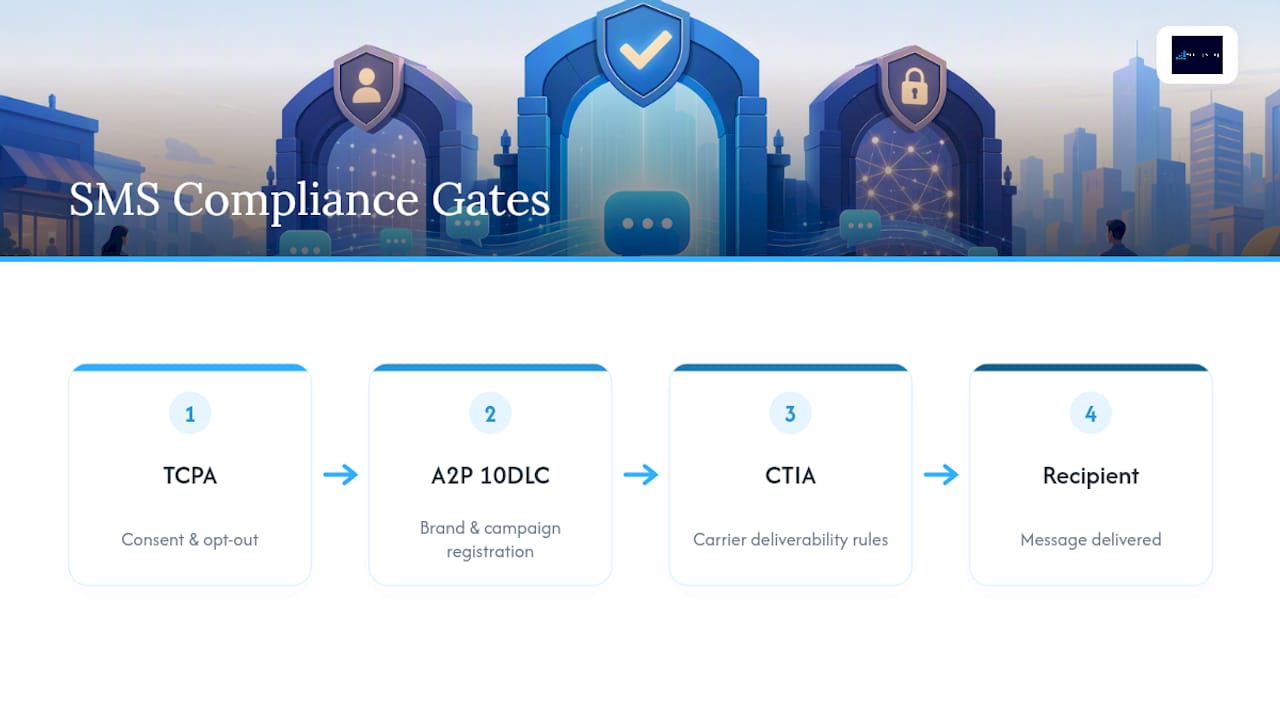
Three separate systems govern text messaging in the United States, and a small business needs to satisfy all three, not just the one that seems most relevant. Miss any piece and your messages either violate federal law or simply never arrive.
TCPA: the legal baseline
The Telephone Consumer Protection Act, enforced by the FCC, requires prior express written consent before you send marketing texts. That consent has to be specific: the person needs to know what kind of messages they’re agreeing to receive, and it needs to come before the first message goes out, not after.
The penalty structure is severe by design. TCPA violations carry statutory damages of $500 to $1,500 per message, with no aggregate cap. A single careless campaign sent to a few thousand unconsented contacts can generate liability that dwarfs a small business’s annual marketing budget.
Consent has to be documented, not just collected. A compliant program includes clear opt-in language that identifies your business, describes the type and frequency of messages, and gets stored with a timestamp. If a customer disputes ever opting in, your records are the only defense you have.
A2P 10DLC: the carrier gatekeeper
Separate from federal law, every business sending text messages to consumers now has to register through The Campaign Registry, the system that underpins Application-to-Person 10 Digit Long Code (A2P 10DLC) messaging. Unregistered traffic is increasingly blocked outright by major carriers, regardless of whether the content itself is legal.
Registration happens in two layers: you register your business as a “brand,” then register each messaging use case as a “campaign” under that brand. Carriers vet both, checking your consent flows, sample messages, and website disclosures before approving traffic. Prepare those documents before you start the registration process, because incomplete submissions are the top reason launches stall for weeks.
CTIA principles: the deliverability layer
Even a fully TCPA-compliant, fully registered campaign can get filtered if it violates CTIA Messaging Principles, the carrier-facing standards that govern content and sender behavior. Legal analysts increasingly warn that compliance has to be operational, not just a legal checkbox, because carriers filter based on their own risk models.
Carriers flag content under the SHAFT categories: Sex, Hate, Alcohol, Firearms, and Tobacco. A promotional text that references any of these, even innocently, risks silent filtering. Your dashboard might show “sent” while the carrier never delivers it, so monitoring delivery reports at the carrier level matters more than trusting your platform’s send confirmation.
The operational checklist
Beyond registration, carriers and regulators expect ongoing controls baked into your sending process:
- Suppression lists that immediately remove anyone who opts out, across every campaign you run.
- Time-zone enforcement so messages never land outside a recipient’s local quiet hours.
- Any-method opt-out handling, meaning STOP, unsubscribe, or even a plain-English “please stop texting me” all have to trigger removal.
- Audit trails that log consent capture, opt-out timestamps, and message history for every contact.
Keep that audit trail for several years, not just a few months. TCPA demand letters and class actions can reach back further than most small businesses expect, and a missing timestamp is the difference between a quick dismissal and a costly settlement.
How Do You Launch a Compliant SMS Program?
Building your first campaign in the right order prevents almost every common failure. Follow these steps and you’ll have a working, defensible program before you send a single promotional message.
- Decide your use case first. Transactional messages, like order confirmations, have lighter consent requirements than marketing texts. Know which one you’re building before you write a single opt-in form.
- Build a compliant opt-in flow. Website checkboxes should read something like: “By checking this box, I agree to receive marketing text messages from [Business Name] at the number provided. Message and data rates may apply. Reply STOP to opt out.” Point-of-sale sign-ups and keyword opt-ins (texting a word to a number) need the same disclosure, spoken or printed. Store the timestamp, IP address, and exact form language used at the moment of consent.
- Register your brand and campaign. Work with your messaging platform, known as a Communication Service Provider, to submit your brand details and campaign use case to The Campaign Registry. Have your privacy policy, terms of service, and sample messages ready. This step alone often takes one to two weeks longer than businesses expect when documentation is incomplete.
- Configure platform controls. Set up suppression lists, time-zone based quiet hours, automated STOP and HELP keyword parsing, and real-time opt-out processing before your first send.
- Pilot with a small segment. Send to your most engaged customers first. This step validates message content and surfaces operational errors, like reassigned phone numbers or slow opt-out processing, before you’re exposed at full volume.
- One-time registration fees cover brand verification and campaign registration through The Campaign Registry, plus possible vetting fees if your platform charges separately for expedited review.
- Per-message costs include your platform’s per-SMS rate plus a carrier surcharge that varies by carrier and message volume; these fees stack per message sent, so volume forecasting matters.
- Operational costs cover consent management tooling, periodic compliance audits, and, for many small businesses, a modest legal review of opt-in language before launch.
- Transactional triggers that fire automatically on order confirmation, shipping, or appointment booking.
- Abandoned-cart flows that text a reminder a few hours after a customer leaves items unpurchased.
- Re-engagement campaigns aimed at customers who haven’t interacted in 60 or 90 days.
- Two-way conversational flows that let customers reply to confirm, reschedule, or ask a quick question.
- Segment by purchase history or appointment type so messages feel relevant, not generic.
- Personalize with the customer’s name and specific product or service details when your platform supports it.
- Never mix promotional content into a transactional message; a shipping confirmation with a coupon buried inside it confuses consent categories and increases legal risk.
- Watch for weak consent language during setup, like a pre-checked box or vague terms; carriers reject these during vetting far more often than businesses expect.
- FCC Second Report and Order and related TCPA materials
- Beyond TCPA compliance: Why CTIA Messaging Principles should shape your SMS campaign design (Holland & Knight, 2026-05-27)
- SMS marketing statistics (SimpleTexting, 2026)
- SMS Marketing Compliance in 2026 (Beancount, 2026)
Pro Tip: Run your pilot against a segment of customers who bought or booked in the last 30 days. They already trust you, which means your opt-out rate during the pilot will reflect message quality, not audience mismatch.
Once your pilot clears a week or two with clean delivery and a low opt-out rate, expand to the next segment. Resist the urge to blast your full list on day one. A slow ramp is what catches problems while they’re still cheap to fix.
What Does SMS Marketing Cost a Small Business?
Budgeting for text message marketing for small businesses means accounting for three separate cost categories, and skipping any one of them is how businesses get surprised by their first invoice.
A realistic pilot budget for a single location testing appointment reminders and one monthly promotion should account for registration fees, a low-volume messaging plan, and a small buffer for platform fees while you learn your actual send volume. Steady operation across a full customer list raises the per-message total but usually lowers the effective cost per conversion, since your list is warmer and better segmented. A business scaling across multiple locations or adding transactional triggers on top of promotions should expect the largest jump in the per-message and platform-fee categories, since that’s where volume compounds fastest.
Making SMS Part of Your Marketing Stack
SMS delivers the most value when it isn’t a standalone tool bolted onto your business. Connecting it to the systems you already run turns one channel into a coordinated program.
Four integrations matter most for small business mobile marketing: your CRM, so every text ties back to a customer record; your eCommerce platform, so cart and order events can trigger automatic messages; your booking or scheduling software, so appointment reminders send themselves; and your helpdesk, so two-way texting from customers routes to a real person instead of a dead end.
Automation is where the time savings actually show up. Once connected, a few patterns cover most small business needs:
A business operations platform that centralizes these connections makes it far easier to see which text actually drove a sale, rather than guessing. Attribution matters here specifically because SMS often works alongside other channels; a customer might see your text, then convert through email or a follow-up call. Track revenue per message alongside your other KPIs so you’re crediting the channel accurately, not double-counting.
Data hygiene deserves a permanent spot on your calendar too. Phone numbers get reassigned to new owners more often than most business owners realize, and texting someone who never opted in because they inherited an old number creates real legal exposure. Run periodic checks against your suppression list and remove numbers that bounce or go inactive for extended stretches.

Best Practices, Templates, and Red Flags to Avoid
The gap between an SMS program that drives revenue and one that quietly bleeds subscribers usually comes down to message quality, not strategy. A few working templates illustrate the difference.
Appointment reminder: “Hi [Name], this is a reminder for your appointment with [Business] on [Date] at [Time]. Reply C to confirm or call us to reschedule. Reply STOP to opt out.”
Shipping update: “[Business]: Your order #[Number] has shipped and should arrive by [Date]. Track it here: [link]. Reply STOP to unsubscribe.”
Show this text at checkout. Reply STOP to opt out.
Every template leads with value, states a clear action, and includes the opt-out line, which isn’t optional. For businesses juggling frequent scheduling, a dedicated reminder workflow can cut no-show rates significantly without adding staff workload.
Frequency and timing rules matter as much as wording. Keep promotional sends to a handful per month at most, and never send outside a recipient’s local morning-to-evening window. A 7 a.m. promo text to someone on the East Coast might land at 4 a.m. for a customer who moved to the West Coast, and that alone generates opt-outs.
Pro Tip: Read every promotional message out loud before sending. If it sounds like you’re shouting a deal at a stranger rather than reminding a customer you know, rewrite it.
Sources
Frequently Asked Questions
Is SMS Marketing Illegal?
No, SMS marketing is legal in the United States, but it’s tightly regulated. You need prior express written consent before sending marketing texts, and TCPA violations carry statutory damages of $500 to $1,500 per message with no cap on total liability.
How Much Does SMS Marketing Cost?
Costs break into three parts: one-time brand and campaign registration fees, per-message platform rates plus carrier surcharges, and operational costs like consent management or compliance review. Budgets vary by message volume, so forecasting your expected send volume before choosing a platform tier avoids surprise bills.
What Are Some Good SMS Marketing Apps for Small Businesses?
The right platform depends on your use case, but look for one with built in A2P 10DLC registration support, suppression list management, and CRM integration rather than a bare-bones sending tool. If you’d rather not manage platform selection and registration yourself, EngageZing’s managed setup handles that evaluation and configuration directly through a free roadmap analysis at roadmap.engagezing.com.
Is SMS Getting Phased On?
No, adoption is climbing, not fading. Roughly three-quarters of businesses now use SMS marketing, and engagement rates remain far higher than most other direct marketing channels when programs stay compliant and relevant.
What’s the Difference Between SMS and Email Marketing?
SMS and email serve different moments rather than competing for the same job. SMS gets read within minutes and works best for urgent, short messages like reminders and time-limited promos, while email handles longer content and visual offers that don’t need instant attention.
Share This Article
Found this useful? Send it to another owner who is still sending texts they hope are compliant.
Share on Facebook · Share on X · Share on LinkedIn · Share on Pinterest
Want More Information? Let’s Talk.
If you would rather not take this on yourself, we handle it for you. Our Business OS (uBOS) service takes care of the setup and the ongoing work, then reports back so you can see exactly what changed. You keep running your business; we keep this moving.
Call us at 631-825-9464 or reach out here. No pressure, no obligation, and you can ask us anything — including whether this is even worth doing for a business your size.
Looking ahead, request your free roadmap analysis and we will map out a 12-month plan to close the conversion leaky bucket so more of the customers you already reach turn into booked work.
Written by Joe Leineke · Content on this blog is generated with AI assistance and independently reviewed and fact-checked by human marketing professionals for accuracy and quality.