
The best call to action tells the visitor exactly what happens after the click. “Get My Analysis,” “Book a Consultation,” “Call for Same-Day Service” and “Get Directions” all do that. “Submit” and “Get Started” do not. Below are call to action examples sorted by business type, the rules behind them, and how to test them. Each tip links to a service that can put it to work for your business.
What makes a call to action work
A CTA is a promise. The button says what you will get, and the next page has to deliver it right away.
People scan pages, so the first words must carry the meaning. Nielsen Norman Group’s guidance on link labels says to be concise, put information-carrying words first, and set expectations that the destination meets immediately. The same group warns that a generic “Get Started” button attracts clicks but can mislead people who only want information.
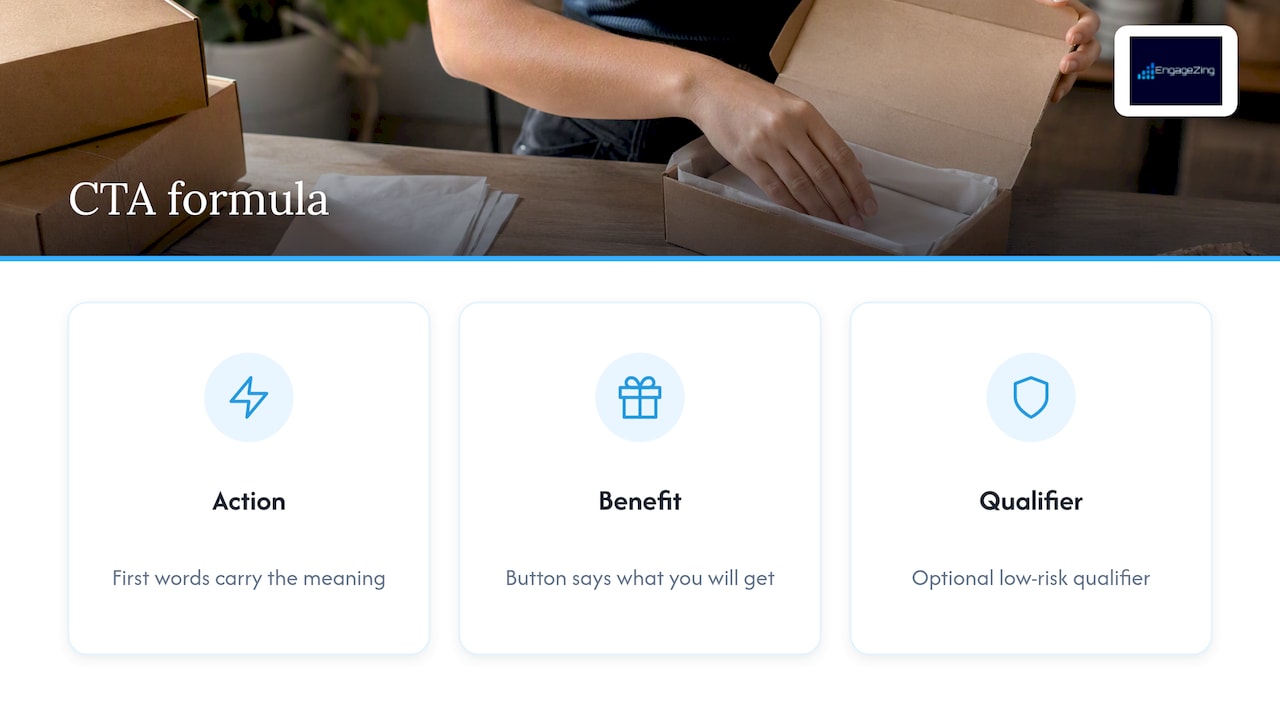
A simple formula covers most cases: action verb + what you get + (optional) low-risk qualifier. “Get My Roadmap Analysis” has all three. “Learn More” has none.
Call to action examples by business type
The right wording depends on what your visitor wants to do next. Use this table as a starting point.
| Business type | Weak CTA | Stronger CTA |
|—|—|—|
| Plumber, HVAC, electrician | Contact Us | Call for Same-Day Service |
| Dentist, salon, clinic | Learn More | Book an Appointment |
| Local retailer | Click Here | Get Directions, Shop Best Sellers |
| Online store | Submit | Add to Cart, See Delivery Options |
| Consultant, freelancer | Get Started | Book a 15-Minute Consultation |
| Marketing or B2B service | Get Started | Get My Analysis |
| Lead magnet | Download | Download the Pricing Guide |
Service businesses: make calling easy
When a form would ask for complex or sensitive details, a phone call is often the faster path. Google and Ipsos found that 61% of mobile searchers viewed click-to-call as important in the purchase phase. Try “Call [Business Name],” “Talk to a Local Expert” or “Request a Quote.”
Track calls separately from form fills, so you know which path brings real jobs. A Google Maps lead playbook for service businesses covers how trackable calls and profile actions fit together.
Local retailers: send people to the door
A shopper nearby wants hours, parking and a route. “Get Directions” and “Shop Best Sellers” serve that need. If you want more of those searchers to find you in the first place, our Near-Me Search Boost is built for “near me” visibility.
E-commerce: remove doubt at the product page
Make the transaction clear: “Add to Cart,” “Buy Now,” “Choose Your Size.” NN/G advises making targets visibly clickable with recognizable conventions. Avoid several competing buttons beside one product image unless each is clearly labeled.
Professionals and freelancers: lower the commitment
“Book a 15-Minute Consultation” feels smaller than “Hire Me.” “See Client Results” invites proof before a sales conversation. Both give the visitor a safe next step.
Where to place your CTA
On mobile, put the primary action front and center. Google and AnswerLab’s mobile study lists keeping calls to action front and center as its first principle of mobile site design. Use “Call Now,” “Get Directions,” “Book an Appointment” or “Request a Quote” in the main body. Keep secondary actions in menus or lower on the page.
Speed matters too. A 2013 Google and Nielsen diary study found that more than half of mobile-search conversions happened within an hour. That is old data, so treat it as context and check your own analytics. Still, it is a good reason to make the action possible on the first screen.
Page design counts as much as button text. A strong CTA on a slow, cluttered page still loses. A website built around conversions puts the CTA, the proof and the next step in one clear path. For a look at what that can mean for trades, see these contractor website examples that bring in leads.
Keep your CTA honest
Confidence sells. Unsupported promises create risk. In the United States, the FTC requires advertising claims to be truthful and substantiated, and its endorsement and testimonial guides say testimonials should reflect typical experiences or clearly disclose when they do not. The FTC’s business guidance on internet advertising repeats the same principle.
In January 2025 the FTC ordered a company to pay $1 million over deceptive claims about what its AI accessibility product could do. That case is a compliance warning, not a marketing benchmark, but the lesson carries over to CTAs.
| Risky | Safer |
|—|—|
| Get 4X More Leads Guaranteed | Request a Personalized Plan |
| Risk-Free Results for Everyone | See Client Results |
| Only 2 Spots Left (when untrue) | Book Your Consultation |
If you are unsure whether a specific claim holds up, ask your attorney before it goes live.
How to test your CTAs
- Pick one goal. Choose a qualified call, a booked consultation, a store visit or a completed purchase.
- Change one thing at a time. NN/G suggests an A/B test for big redesigns, then smaller tests of label, placement, supporting text or visual treatment.
- Judge by outcomes. Clicks are not customers. Count what reaches your revenue.
- Remember interactions. Button copy, imagery and form length affect each other, so test the whole experience.
Our perspective: a CTA is only as good as the offer behind it
We see the same pattern with small business owners. They rewrite the button and leave the offer alone. A sharper label helps, but a visitor clicks when the next step is worth their time and carries no risk.
That is why our own main CTA leads with: a roadmap analysis that shows where your site and listings lose leads. Every CTA on your site should answer one question for the visitor: what do I get, and what does it cost me? If the answer is clear and honest, the label almost writes itself.
We also pair CTAs with the rest of the path. Reviews build the trust that makes someone call. Automated review requests and a 90-day plan for service business leads work alongside strong CTAs, not instead of them.
Put these CTAs to work with a roadmap
Writing CTAs is easy. Knowing which ones your business needs is harder. Our Conversion Roadmap, 12-month Growth Roadmap and High Converting Website Mockup are included in the analysis. They show where your visitors drop off and what to change first, and our local experts walk you through them.
If you want the full conversion picture, see our 4x Conversions page. If ads drive your traffic, our Google advertising and email marketing services send people to pages built to convert.
Frequently Asked Questions
What is an example of a good call to action?
“Get My Analysis” is a good one. It names the action, the benefit and the price in three words. Other strong examples are “Book a Consultation,” “Call for Same-Day Service” and “Get Directions.”
How long should a CTA be?
Keep it short, usually two to five words. Put the words that carry meaning first, because visitors scan. Add a short line of supporting text underneath if you need to clarify cost or time.
Is “Get Started” a bad CTA?
Often it is too vague. NN/G found it can mislead people who only want information, since it could mean a signup, a quiz or a sales funnel. Name the step instead, for example “Book a 15-Minute Consultation.”
How many CTAs should a page have?
One primary CTA per page, repeated where the visitor is ready to act. Add a quieter secondary option, such as “See Client Results,” for people who are not ready yet. Several equal buttons compete and slow decisions.
Where can I get my CTAs reviewed?
We offer a personalized analysis that covers your website, listings and conversion path. Get My Analysis and one of our local experts will help.
Ready to see what your site is missing? Get My Roadmap Analysis
Share This Article
Found this useful? Send it to another owner who is still the same questions keep coming up.
Share on Facebook · Share on X · Share on LinkedIn · Share on Pinterest
Want More Information? Let’s Talk.
If you would rather not take this on yourself, we handle it for you. Our 4X Conversions service takes care of the setup and the ongoing work, then reports back so you can see exactly what changed. You keep running your business; we keep this moving.
Call us at 631-825-9464 or reach out here. No pressure, no obligation, and you can ask us anything — including whether this is even worth doing for a business your size.
Looking ahead, request your roadmap analysis and we will map out a 12-month plan to close the conversion leaky bucket so more of the customers you already reach turn into booked work.
Written by Joe Leineke · Content on this blog is generated with AI assistance and independently reviewed and fact-checked by human marketing professionals for accuracy and quality.