You can remove a negative Google review only if it breaks Google’s content policies. Genuine, policy-compliant negative reviews stay up, no matter how unfair they feel. Report policy violations right away through your Business Profile or the Reviews Management Tool. If the review is legitimate but harsh, skip the removal fight and respond publicly instead. And steer clear of paying for removal or threatening reviewers. The FTC’s 2024 rule makes both illegal.
How to Remove Negative Google Reviews: What Actually Qualifies
Google will not delete a review just because it hurts. It removes reviews only when they violate specific content policies, and the categories are narrower than most business owners expect.
The eligible categories break down like this:
- Spam or fake content — reviews from bot accounts, competitors posing as customers, or reviewers who never interacted with your business.
- Conflict of interest — a current or former employee reviewing their own employer, or a competitor leaving a one-star drive-by.
- Off-topic content — complaints about a landlord dispute, a political rant, or anything unrelated to the actual customer experience.
- Hate speech or harassment — slurs, threats, or content targeting someone’s identity.
- Impersonation — a reviewer pretending to be someone else, including a former customer’s identity theft.
- Inappropriate images or profanity — visual or written content that violates Google’s content and rating manipulation policies.
Google’s moderation leans conservative. It runs mostly on automated systems built to catch obvious spam and abuse at scale, which means genuinely fake reviews sometimes slip through, and borderline legitimate complaints occasionally get flagged in error. Neither outcome is personal. It is just the nature of automated review at scale.
The strength of your case comes down to evidence. Order confirmations, timestamps, screenshots of the offending text, and any record showing the reviewer never did business with you all matter far more than a well-written complaint.
How to Report a Fake or Policy-Violating Google Review
Reporting a review correctly takes minutes, but sloppy reports get rejected just as fast as they get filed. Here’s the process:
- Open the review in Google Maps or your Business Profile, and click the three-dot menu next to it.
- Select “Report review” (or route the report through the Reviews Management Tool if you manage multiple locations).
- Choose the specific policy reason. Don’t select “other” when “spam” or “off-topic” applies.
- Attach evidence. A screenshot of the review, a note tying it to a policy clause, and any transaction records that prove the reviewer was never a customer.
- Submit and note the date, so you can track how long the review sits in pending status.
- Google’s appeal process is a one-time option per decision, so make it count. Include only your strongest evidence, mapped directly to the policy clause you believe was violated.
- Expect one of a few statuses: decision pending, reviewed with no policy violation found, or escalated for further review. None of these move quickly. Give it one to two weeks before assuming it’s stalled.
- If the appeal fails and the review is clearly defamatory or fraudulent, a consultation with an attorney is reasonable. Legal action rarely removes a review fast, but it can matter if the content includes false factual claims that cause measurable harm.
- Reply within 24 to 48 hours. Delayed responses read as indifference.
- Never offer payment or a discount specifically to get the review changed. That crosses into the same territory the FTC now polices.
- Once resolved, you can invite the customer to update their review voluntarily, but never make the update a condition of the resolution.
- Keep fresh, unprompted reviews coming in. A systematic review-generation strategy pushes older negative reviews further down the page and gives new visitors more recent, balanced context.
- Report inappropriate reviews on your Business Profile — official steps for flagging policy violations.
- Appeal Business Profile content and profile restrictions — appeal eligibility and status outcomes.
- FTC final rule on consumer reviews — the legal text governing review suppression.
- FTC Q&A on the reviews rule — plain-language guidance on what’s prohibited.
Pro Tip: Write your report like a policy memo, not a complaint letter. One sentence stating which rule was broken, backed by evidence, gets processed faster than three paragraphs about how the review made you feel.
Avoid mass-reporting reviews you merely dislike. Google’s systems flag accounts that file frequent, low-evidence reports, and that can slow down your legitimate ones.
What Happens if Google Denies Your Report?
Most reports resolve within a few days, but not every outcome favors the business. When Google rejects a report, you get one shot at a formal appeal.
What the FTC’s Review Rule Means for Your Removal Strategy
The FTC’s Trade Regulation Rule on Consumer Reviews and Testimonials went into effect on October 21, 2024, and it changes what business owners can legally do about bad reviews.
The FTC can now seek civil penalties for businesses that buy fake reviews, sell them, or use unfair suppression tactics against real ones, according to the agency’s own announcement.
The rule targets three common but risky moves: paying a reviewer to delete or edit a truthful negative review, sending unfounded legal threats to intimidate a reviewer into silence, and orchestrating a wave of fake positive reviews to bury a real complaint. The FTC’s own guidance is explicit that offering compensation to change a truthful review can violate the FTC Act, separate from the new rule entirely.
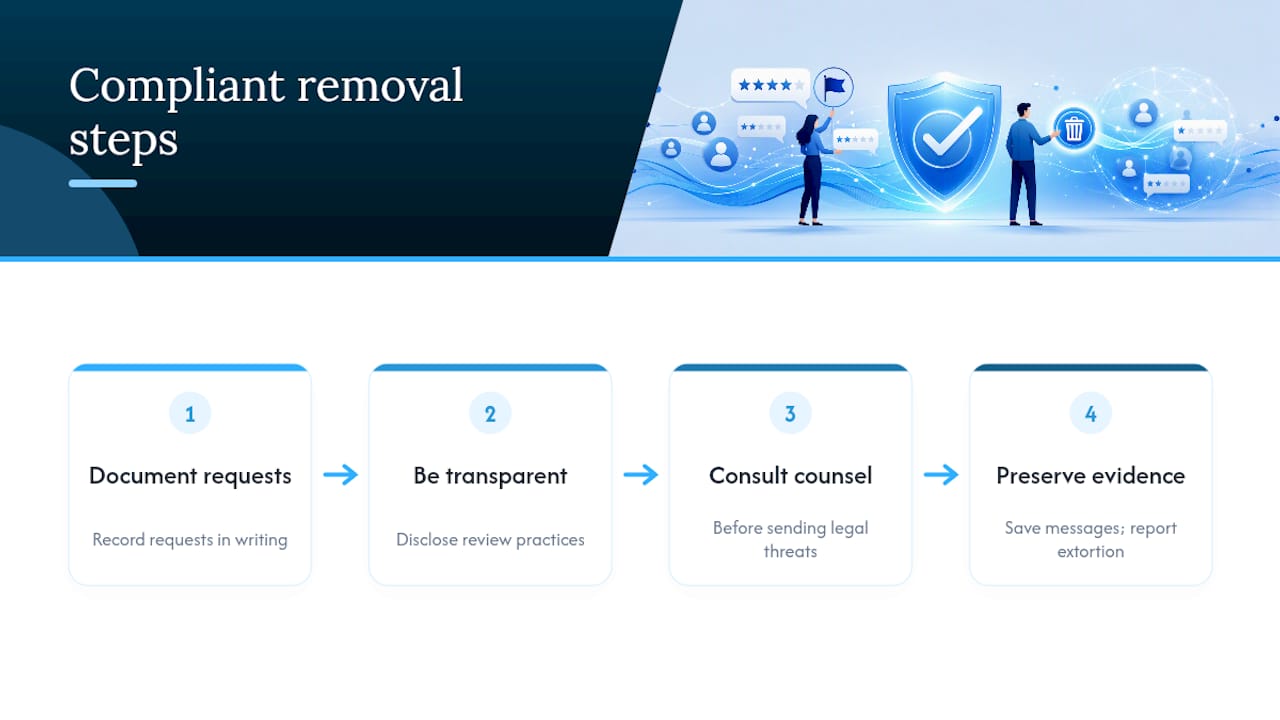
The compliant path is simpler than it sounds. Document every removal request in writing, keep review-generation practices transparent, and talk to counsel before sending any legal threat. If you suspect extortion (someone demanding payment to delete a bad review), save every message and report it. That’s evidence, not something to negotiate quietly.
Responding to Negative Google Reviews You Can’t Remove
Most negative reviews that survive a report are simply real. A customer had a bad experience, and Google correctly decided that opinion, however unwelcome, does not violate policy. This is where response quality matters more than removal attempts.
A solid public response does four things: acknowledges the complaint, states you looked into it, offers to resolve the issue offline, and invites the reviewer to follow up. Avoid language that reads as an admission of fault. “We’re sorry this happened” works. “We should have caught this before it shipped” can become a liability in a dispute.
Pro Tip: Post photos and Business Profile updates regularly. An active profile with recent, positive activity does more to offset one bad review than any removal attempt ever will.
When It’s Time to Bring in a Specialist
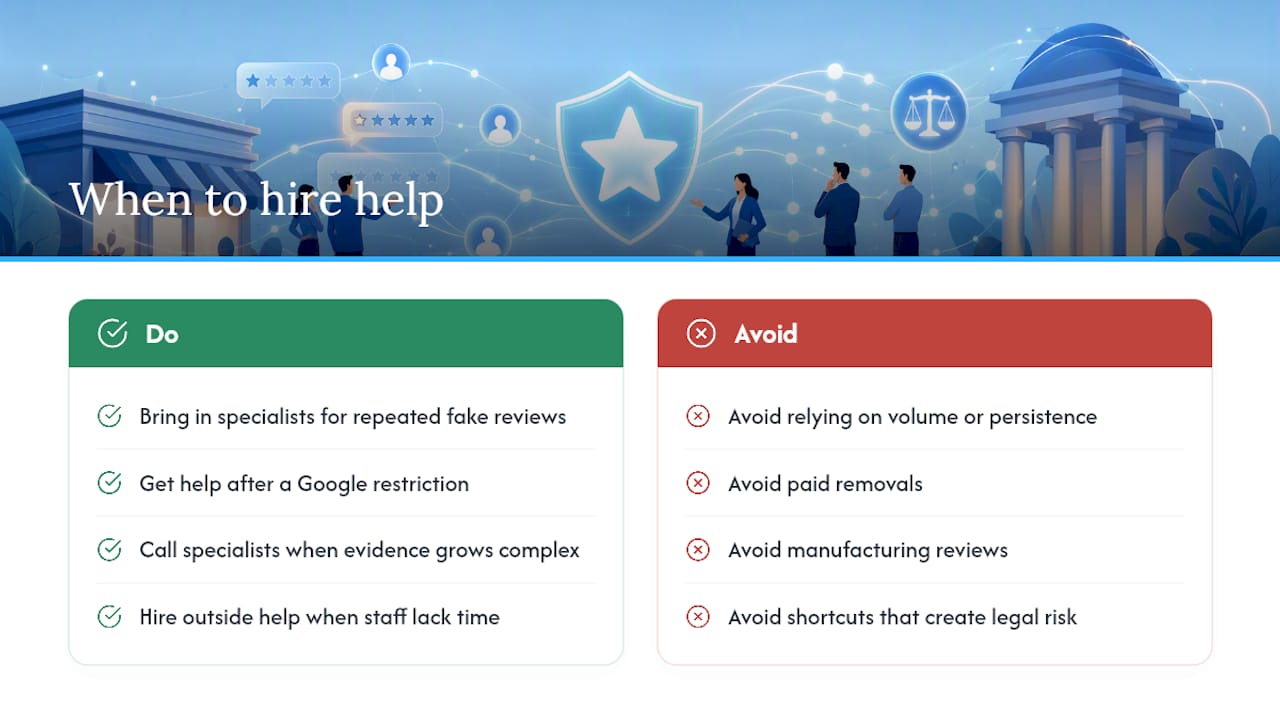
Joe has spent years watching business owners fight review battles they were never equipped to win alone, largely because reporting is a documentation exercise, not an emotional one. EngageZing’s business listings and profile management work centers on exactly that discipline: mapping evidence to policy language instead of hoping volume or persistence changes Google’s mind.
Bringing in outside help makes sense when a business faces repeated fake-review attacks, a Google-imposed restriction on its profile, evidence collection that’s grown too complex to track internally, or simply not enough staff time to do it right. EngageZing pairs review-generation systems with hands-on profile services so businesses build a review base strong enough that a stray negative review barely registers. Every method used follows Google’s policies and the FTC’s rules. No paid removals, no manufactured praise, no shortcuts that create legal exposure down the line.
The Real Problem Isn’t the Bad Review. It’s the Weak Response System
Most advice on this topic treats review removal as the goal, and that’s backwards. Removal is a narrow tool that applies to a narrow slice of cases: fake accounts, competitor sabotage, off-topic rants. For the overwhelming majority of negative reviews, the ones written by real, dissatisfied customers, there is no removal path, and pretending otherwise wastes time better spent elsewhere.
The businesses that come out ahead treat a bad review as a visibility problem, not a legal one. One negative review buried under fifty recent, genuine positive ones barely moves the needle on conversion. One negative review sitting alone on a profile with six total reviews is a crisis. The fix in that second case is never a Google appeal. It’s volume, consistency, and a response that shows a real human is paying attention.
The FTC’s 2024 rule also changes the calculus in a way few owners have internalized yet: the aggressive removal tactics some reputation firms quietly used for years (cash-for-deletion, legal intimidation) now carry real civil penalty exposure. Compliance isn’t the cautious option anymore. It’s the only defensible one.
Where to Verify This Information
This article is general information, not a substitute for advice from a qualified lawyer. Consult a qualified legal professional about your own circumstances before acting on anything here.
Frequently Asked Questions
Can I remove a negative Google review?
Only if it breaks Google’s content policies: fake accounts, competitor spam, impersonation, off-topic rants or prohibited content. Genuine negative reviews stay up no matter how unfair they feel.
Is paying someone to remove reviews legal?
No. The FTC’s 2024 rule on consumer reviews prohibits paying for or threatening the removal of truthful negative reviews, and the penalties are real.
What should I do about a bad review I cannot remove?
Respond publicly, briefly and professionally, name the remedy you offered, and build review volume so the negative one reads as an outlier rather than the pattern.
Share This Article
Found this useful? Send it to another owner who is still fighting a review they cannot legally remove.
Share on Facebook · Share on X · Share on LinkedIn · Share on Pinterest
Want More Information? Let’s Talk.
If you would rather not take this on yourself, we handle it for you. Our Review Generation & Reputation service takes care of the setup and the ongoing work, then reports back so you can see exactly what changed. You keep running your business; we keep this moving.
Call us at 631-825-9464 or reach out here. No pressure, no obligation, and you can ask us anything — including whether this is even worth doing for a business your size.
Looking ahead, request your free roadmap analysis and we will map out a 12-month plan to close the conversion leaky bucket so more of the customers you already reach turn into booked work.
Written by Joe Leineke · Content on this blog is generated with AI assistance and independently reviewed and fact-checked by human marketing professionals for accuracy and quality.