Pick PPC when you need leads or sales within weeks and have budget to spend on clicks; pick SEO when you can invest six to 24 months building organic visibility that keeps paying off after you stop spending. Most businesses eventually need both, but if you’re starting today with limited runway, run PPC first to generate revenue and validate what actually converts, then reinvest in SEO once you know what’s working.
TL;DR:
PPC provides immediate traffic and conversions but requires ongoing spend, making it ideal for short-term revenue and testing messaging. SEO builds long-lasting organic rankings that compound over time and can reduce marginal costs, but it takes six to 12 months to see significant results. Combining PPC and SEO strategies using shared keyword data and attribution improves overall visibility and conversion efficiency more than using either channel alone. Start with PPC if you need rapid results within 90 days, then reinvest in SEO to establish sustainable, persistent traffic. Continuously monitor market signals such as rising CPCs or drops in organic traffic to rebalance your focus between paid and organic channels.
PPC vs. SEO at a Glance: The Core Differences
The fastest way to understand paid search vs. SEO is to look at how each one behaves over time, not just what it costs.
PPC (pay-per-click advertising through platforms like Google Ads) puts your business at the top of search results the moment your campaign goes live. SEO (search engine optimization) earns that same position gradually, through content, technical fixes, and links, without paying for each click. Google’s own guidance is blunt about the boundary between them: running ads does not improve your organic rankings, and stopping your ads does not hurt them either. The two systems operate independently, even when they show up on the same results page.
Here’s how the core mechanics stack up:
- Speed: PPC generates traffic within hours of launch. SEO typically needs three to six months before you see meaningful movement.
- Cost model: PPC charges per click or impression, so cost scales directly with volume. SEO has upfront labor and content costs but no per visitor charge.
- Durability: PPC traffic stops the moment you stop paying. SEO rankings persist and often compound as pages accumulate authority.
- Targeting granularity: PPC lets you target by device, location, time of day, and audience segment almost instantly. SEO targeting is shaped by content and site structure, which changes more slowly.
- Measurability: PPC gives near real-time conversion data. SEO results take longer to attribute cleanly, especially with multi-session buyer journeys.
One wrinkle worth flagging: AI-generated summaries and answer boxes now sit above traditional organic listings for many informational queries, which can shrink the clicks available even to a first-place organic result. That shift matters most for research-stage keywords. It matters less for high-intent, transactional searches where users still want to click through to compare options.
If you only have time for one takeaway, it’s this: choose PPC when speed is the constraint, choose SEO when durability is the constraint, and revisit the choice as your business changes.
What Are the Pros and Cons of SEO vs. PPC?
Neither channel is universally better. Each one solves a different problem, and the right pick depends on what you can’t afford to wait for.
SEO benefits:
- Traffic compounds over time. A blog post or service page ranking well in month 14 can still be driving leads in month 30 without added spend.
- Marginal cost per visitor drops as pages mature, unlike PPC where every click carries a fresh charge.
- Organic rankings build trust; many buyers still perceive an organic listing as more credible than a paid ad.
- Strong organic content increasingly feeds AI-generated answers and citations, giving well-optimized sites visibility inside those summaries too.
- The ramp is slow. Expect limited results for the first three to six months, sometimes longer in competitive categories.
- Algorithm updates can shift rankings overnight, sometimes erasing months of progress.
- It demands sustained investment in content, technical maintenance, and links, not a one-time project.
- Visibility is immediate. Launch a campaign today, and you can have clicks and conversions by tomorrow.
- Targeting precision lets you reach specific audiences, locations, and devices without waiting for content to rank.
- You can test messaging, offers, and landing pages in days rather than months.
- Spend scales predictably. Want more leads next month? Increase budget.
- Traffic disappears the moment budget runs out; there’s no equity carried forward.
- Cost-per-click tends to rise in competitive verticals as more advertisers bid on the same terms.
- Ongoing spend is required indefinitely to sustain volume.
- Blended CAC: total marketing spend divided by total new customers, regardless of channel.
- Revenue per search: total revenue divided by total branded and non-branded search volume, a useful proxy for overall search visibility health.
- Assisted conversions: conversions where SEO or PPC played a supporting role earlier in the journey, even if another channel closed the sale.
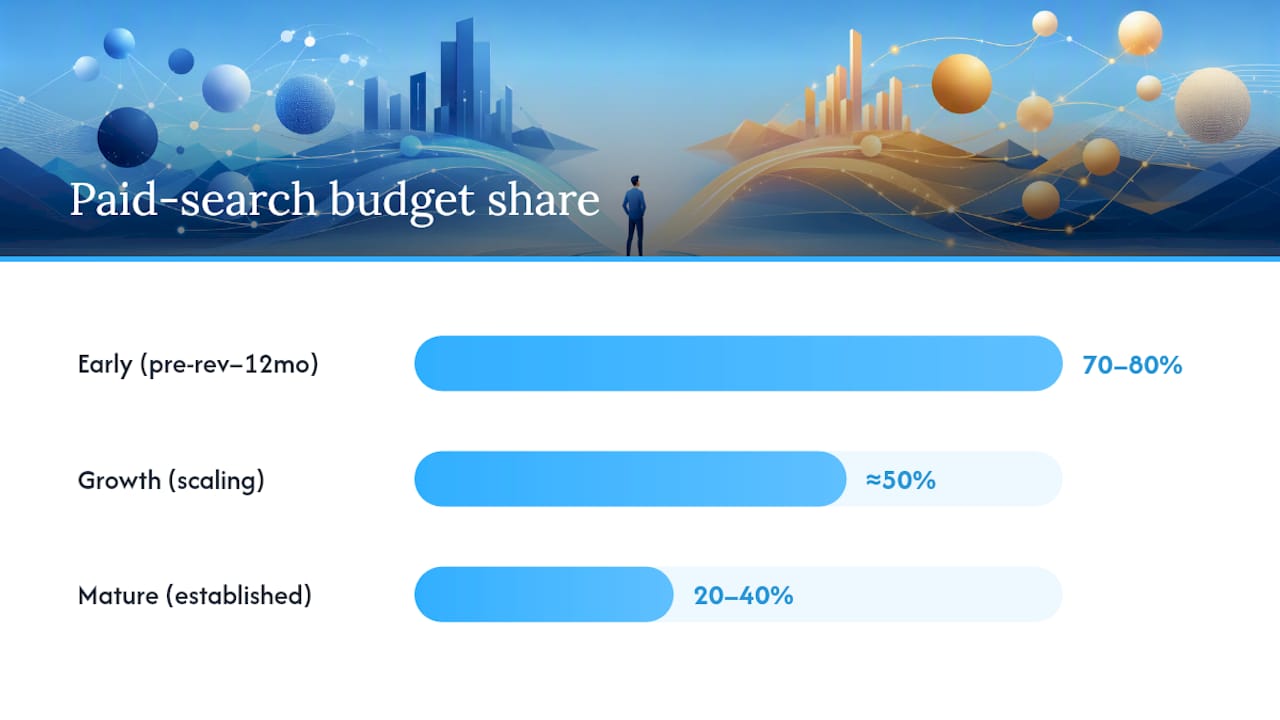
- Early stage (pre-revenue to first 12 months): Lean PPC-heavy, often 70 to 80 percent of digital budget toward paid search. You need revenue and data now, and you likely don’t have the domain authority for SEO to move quickly anyway.
- Growth stage (established product-market fit, scaling spend): Shift toward a balanced mix, often close to 50/50. SEO investments made in year one should be starting to compound, letting you dial back PPC dependency on your best-performing terms.
- Mature stage (established brand, steady demand): Lean SEO-heavy, often 60 to 80 percent organic focus, using PPC selectively for new product launches, defensive bidding on brand terms, or short-term promotions.
- Promote a high-converting PPC landing page into an organic content push once it proves itself with real conversion data.
- Feed your best-performing ad headlines into title tag and meta description tests, since both are fighting for the same click in a results page.
- Track assisted conversions using position-based (U-shaped) attribution, which credits both the first touch and the closing touch instead of only the last click.
- SEO vs. PPC: Understanding the Difference – Google Ads
- SEO vs. PPC: Key Differences Explained
- PPC and SEO Together | Integrate Paid and Organic Search
- SEO and PPC Integration: The Complete Framework
SEO drawbacks:
PPC advantages:
PPC disadvantages:
A cash-strapped startup with three months of runway usually needs PPC’s immediacy. A seasonal retailer promoting a two-week sale often gets more from a short PPC burst than from SEO, which won’t rank in time. A business selling a high-lifetime-value service, like a home renovation contractor, can justify a slower SEO build because each customer is worth pursuing patiently. A product launch frequently benefits from both: PPC to generate initial buzz and data, SEO to sustain visibility after the launch budget dries up.
How Do You Compare the Cost and ROI of Each Channel?
Comparing SEO and PPC economics fairly means resisting the urge to judge them on the same timeline.
PPC cost is transparent and immediate: you pay per click, and that cost shows up on your invoice within the billing cycle. SEO cost is upfront and diffuse. You’re paying for content creation, technical work, and possibly outside help, and that investment needs to be spread across 12 to 36 months to see the true cost per acquired customer. Treating a $5,000 SEO project as a one-month expense wildly understates its long-term return, the same way treating one month of PPC spend as your total advertising cost ignores that the spend never stops.
A simple way to model this: divide total channel investment by the number of customers it produced over the same window, then compare that figure against average customer lifetime value. Run this for PPC over a 90-day window and for SEO over a 12-month window, and you get a much more honest comparison than lining up last month’s numbers side by side.
That’s where blended KPIs matter more than channel-specific ones:
Last-click attribution systematically undercounts SEO’s contribution, since organic touches frequently happen early in a buyer’s research before a paid ad or direct visit closes the deal. Search Engine Journal’s guidance on treating paid and organic as complementary channels is built on this exact insight: sharing keyword and performance data between the two prevents duplicated spend and reveals a coordination lift that last-click reporting hides. Backlinko has documented that a combined paid and organic presence increases total click-through rate beyond what either channel achieves alone, which is a strong argument for tracking them together rather than in isolation.
How Long Does It Take to See Results From PPC or SEO?
Timelines are where most budget conversations go wrong, because PPC and SEO operate on fundamentally different clocks.
PPC timeline: Campaigns typically show early signals, click-through rate, cost per click, initial conversion rate, within the first one to two weeks. By 30 days, you should have enough data to know whether your targeting and messaging are working. Meaningful optimization usually takes 60 to 90 days as the algorithm gathers conversion data and you refine bids and creative.
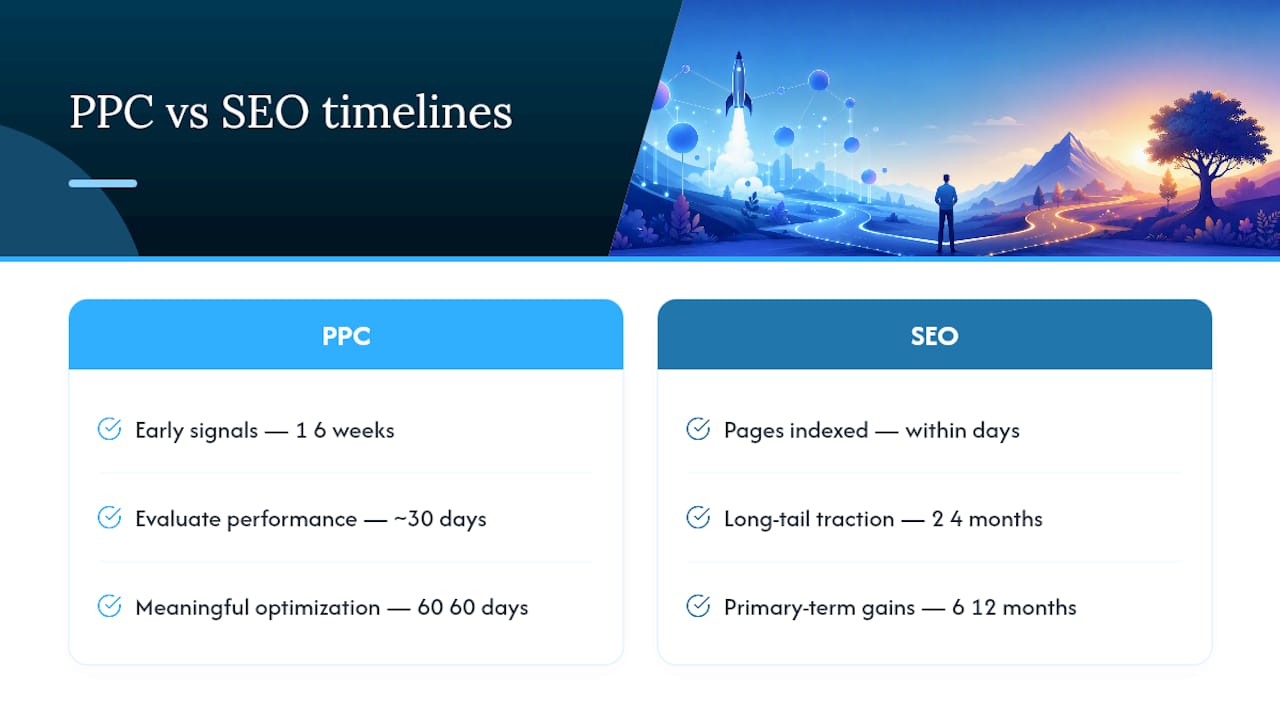
SEO timeline: New pages typically get indexed within days, but ranking movement for competitive commercial terms takes far longer. Long-tail keywords often show traction in two to four months. Ranking gains for your primary commercial terms, the ones tied directly to revenue, usually take six to 12 months, sometimes longer in crowded categories. Google’s own comparison of the two channels confirms this asymmetry directly: paid visibility is immediate, organic visibility builds over time.
Several factors shift these timelines in either direction. High competition and elevated CPCs slow PPC ROI even though the traffic itself is instant. Existing domain authority speeds up SEO considerably. A site with years of accumulated trust can rank a new page in weeks; a brand-new domain might wait months for the same content to gain traction. AI Overviews and other SERP features are compressing the click volume available at the top of organic results for some informational searches, which means SEO success increasingly has to be measured by visibility and assists, not just clicks.
Which Channel Should You Prioritize by Business Stage?
The right mix isn’t fixed. It shifts as your business matures, and the smartest operators rebalance deliberately instead of sticking with whatever they started with.
Pangolin Marketing’s stage-based allocation framework reflects this same logic: budget follows where the business actually needs speed versus where it can afford to build.
Three questions cut through most of the indecision. Do you need customers in the next 90 days? If yes, fund PPC now. Do you have the runway and budget to invest for six months or more without needing immediate payback? If yes, start SEO in parallel. Is your customer lifetime value high enough to justify a patient acquisition cost? If yes, weight your long-term spend toward SEO even if PPC feels more urgent today.
Watch for pivot signals that mean it’s time to rebalance: rapid CPC inflation in your category (a sign PPC is getting less efficient), a sudden organic traffic drop after an algorithm update (a sign of over-reliance on rankings you don’t control), or a conversion funnel problem that no amount of additional traffic, paid or organic, will fix. Pro Tip: Run a small PPC campaign on your target keywords before writing a single SEO article. Ad performance tells you which keywords actually convert, days or weeks before an SEO campaign could confirm the same thing.
How Do You Run SEO and PPC Together Without Wasting Spend?
The businesses that get the most out of digital marketing don’t pick a lane. They coordinate the two channels so each one covers the other’s blind spot.
Start with a shared keyword inventory. Both your PPC and SEO teams, even if that’s just you wearing two hats, should work from the same list of target terms, tagged by intent and current performance. Map every landing page by intent rather than by which channel currently owns it; a page built to convert should serve both paid traffic and organic visitors equally well. Use your PPC data to prioritize what SEO content to write next: whichever ad groups are converting at the highest rate point to the topics worth an organic push. And keep tight negative-keyword discipline so you’re not paying for clicks on terms where you already rank first organically.
A few concrete tactics worth borrowing:
For measurement, blended CAC and revenue per search work better as shared team KPIs than channel-specific numbers that create competing incentives between whoever runs paid and whoever runs organic.
Pro Tip: Don’t stop bidding on a query just because you now rank first for it organically. Run an incrementality test first, pausing PPC on that term for a set window and watching total clicks and conversions, because in many cases the paid and organic listings are capturing different segments of the same search.
Frequently Asked Questions
Should I start with PPC or SEO?
Start with PPC when you need leads inside 90 days and have budget for clicks. Start with SEO when you can invest six months or more and want traffic that keeps paying off after you stop spending.
How long does SEO take to work?
Long-tail terms often move in two to four months, but ranking for your main commercial terms usually takes six to 12 months. Paid search shows signals within one to two weeks by comparison.
Can I run PPC and SEO at the same time?
Yes, and they work better together. Share one keyword list, map landing pages by intent, use PPC conversion data to decide what to write next, and pause paid only after an incrementality test.
Sources
Share This Article
Found this useful? Send it to another owner who is still deciding between ads and SEO with no clear answer.
Share on Facebook · Share on X · Share on LinkedIn · Share on Pinterest
Want More Information? Let’s Talk.
If you would rather not take this on yourself, we handle it for you. Our Google Advertising service takes care of the setup and the ongoing work, then reports back so you can see exactly what changed. You keep running your business; we keep this moving.
Call us at 631-825-9464 or reach out here. No pressure, no obligation, and you can ask us anything — including whether this is even worth doing for a business your size.
Looking ahead, request your free roadmap analysis and we will map out a 12-month plan to close the conversion leaky bucket so more of the customers you already reach turn into booked work.
Written by Joe Leineke · Content on this blog is generated with AI assistance and independently reviewed and fact-checked by human marketing professionals for accuracy and quality.