AI Overviews tend to reduce referral clicks compared with standard search results, so the single most urgent move is confirming your pages are crawlable and indexable while your Search generative AI control settings are configured the way you want them. From there, a prioritized checklist and a clear measurement plan will tell you exactly how much impact you are dealing with and what to fix first.
What Are AI Overviews and When Do They Appear?
AI Overviews are Google’s AI-generated summaries that appear at the top of search results, pulling together information from multiple sources and linking out to the pages they draw from. You will usually see a short summary paragraph followed by a handful of cited links, often just below the search bar and above the traditional organic results.
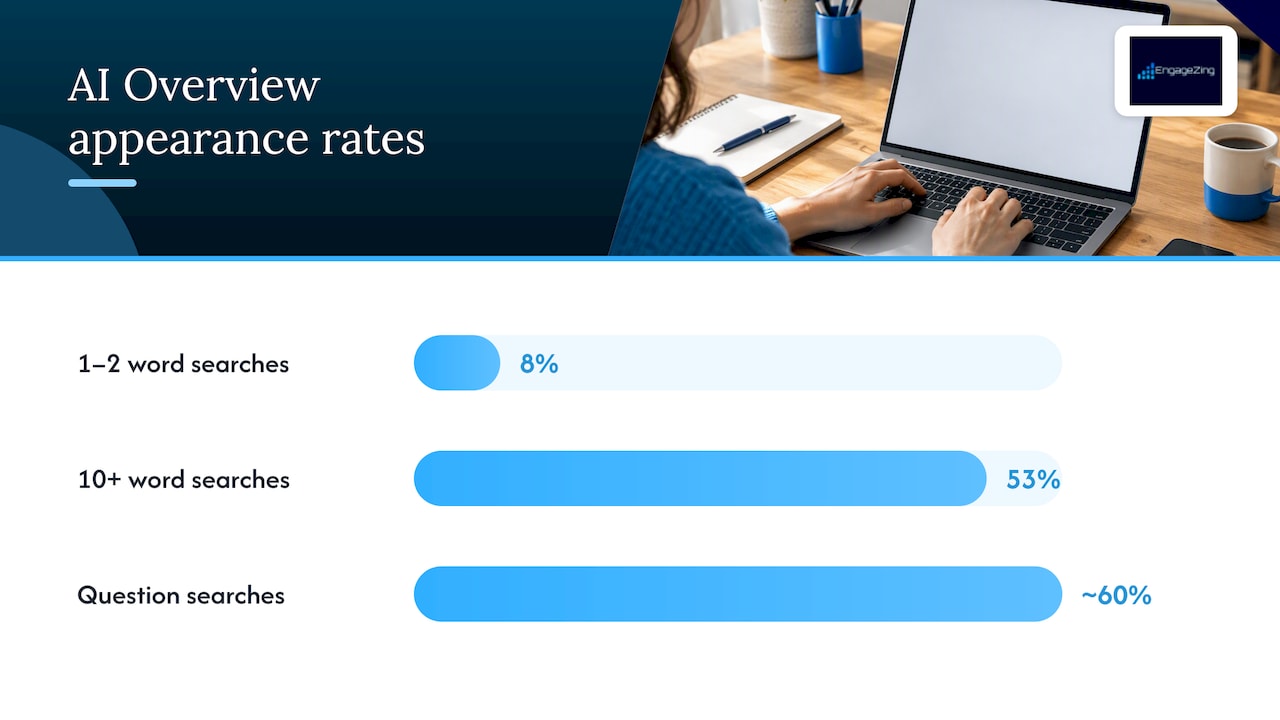
They show up more often on longer, question-based searches than on short, simple ones. Research tracking this behavior found that AI summaries appeared for only 8% of one or two word searches, compared with 53% of searches using 10 or more words, and question-based searches like “why” or “how” triggered a summary roughly 60% of the time, according to Pew Research Center. That pattern matters for how you plan content: a page built to answer “what is digital accessibility” has a better shot at triggering a summary than a page targeting a one-word brand term.
The sources Google tends to cite also follow a pattern. Large reference sites like Wikipedia, major video platforms, community forums, and government domains show up often as cited sources, according to industry reporting on the Pew findings. That concentration is worth knowing because it shapes who gets picked and why: sites with clear, well-sourced answers and strong authority signals have a real path into these citations, even without being a household name.
How AI Overviews Work: Summarizing and Grounding Content
Google’s generative model reads across multiple pages, synthesizes the key points into a short summary, and attaches citations to the facts it pulls in. Those citations exist so the model can point back to where a claim came from, which Google describes as part of how its AI features function across Search.
Before any of that synthesis happens, your page has to clear a basic hurdle: it needs to be crawled, indexed, and resolved to a clean canonical URL. A page blocked by robots.txt, marked noindex, or tangled in duplicate-content signals never reaches the pool of candidates the model draws from, no matter how well written it is.
Once a page is eligible, clarity does the rest of the work. Content organized around a direct answer near the top, followed by clearly labeled sections, gives the model an easier target to extract and attribute. Vague intros, buried conclusions, and walls of unstructured text make that extraction harder and less reliable.
A few practical takeaways follow from this:
- Put the direct answer in the first few sentences, not after three paragraphs of setup.
- Use descriptive headers that match how people actually ask the question.
- Make individual facts easy to quote on their own, since the model often lifts a sentence or two rather than a whole paragraph.
- Support claims with links to primary sources, since grounded, well-cited pages are more attractive candidates for citation themselves.
How to Appear in AI Overviews: A Step-by-Step Checklist
Getting cited in an AI Overview is not luck. It comes down to technical health, content clarity, and authority signals working together, in that order of priority.
Technical foundation, fix this first:
- Confirm your key pages are crawlable and indexed in Google Search Console, with no stray noindex tags or blocked paths in robots.txt.
- Set a clean canonical URL on every page so Google resolves duplicate or near-duplicate content to one authoritative version.
- Check mobile rendering, since Google indexes primarily from the mobile version of your pages.
- Add structured data where it applies, including FAQ, Product, or Article schema, to help Google parse your content accurately.
- Open each key page with a 50 to 120 word answer that directly addresses the question in the headline or title tag.
- Structure the rest of the page with headers phrased as natural questions, followed by short, direct answers.
- Cite your own sources explicitly when making factual claims, rather than asserting numbers with no backing.
- Use short bulleted steps for processes instead of dense paragraphs, since scannable formatting tends to extract more cleanly.
- Earn mentions and links from sites with real topical authority in your space.
- Reference primary sources like .gov, .edu, or major publications when you cite data, since those sources carry more weight as grounding material.
- Build consistent brand mentions across the web so Google has more signals tying your name to your expertise.
- Review the Generative AI performance report monthly alongside your standard Search Console performance data.
- Watch for pages where AI impressions are climbing but clicks are flat, since that signals a summary is answering the question before anyone reaches your site.
- Opting out means your pages cannot be cited in AI Overviews, which also means they cannot generate AI impressions or AI-driven clicks.
- Staying opted in keeps you eligible for citation exposure, even on queries where you would not otherwise rank in the top organic positions.
- A brand with sensitive proprietary data, or one actively weighing content-reuse concerns, may lean toward opting out, while most businesses seeking visibility benefit from staying included.
- Lead with a direct, 50 to 120 word answer to the core question before any background or context.
- Use question-phrased headers that mirror how people actually search, not internal jargon.
- Keep individual facts and figures stated clearly and attributed to a named source, never vague.
- Add structured data, including FAQ schema, where your content naturally supports question-and-answer formatting.
- Build internal links between related pages so Google understands the topical depth of your site, not just a single strong page.
Content clarity, build this next:
Authority signals, build over time:
Conversion, protect the clicks you still get:
The visitors who do click through after seeing a summary are often more decided and closer to acting, so your landing pages need to earn that attention immediately. A clear call to action, visible trust markers, and review snippets near the top of the page matter more now, not less, because every click is doing more work than it used to.
Pro Tip: Fix crawl and index errors before touching content. A perfectly written page that Google cannot reach will never be cited, no matter how good it is.
Once the technical basics are solid, treat content and authority fixes as ongoing work. Review your Search Console data monthly, and A/B test landing page elements like headline clarity and CTA placement every few weeks rather than overhauling everything at once.
Measuring Performance With the Generative AI Report
You cannot manage what you cannot see, and guessing at AI Overview impact from gut feel leads to the wrong fixes. Google’s Search Console offers a Generative AI performance report built specifically to show impressions and clicks tied to features like AI Overviews and AI Mode, broken down by page, country, and device, according to Search Console Help. That report is the authoritative source for this data. Third-party tools can estimate AI visibility, but they are guessing at something Google already measures directly for your property.
A simple before-and-after approach works well. Pick a set of comparable queries or pages, track their AI impressions against traditional organic impressions over a few weeks, and watch how the ratio shifts as you make changes.
| Metric | What it tells you |
|—|—|
| AI impressions | How often your content appears inside an AI Overview |
| AI clicks | How many of those impressions turn into a click to your site |
| AI CTR | Click rate specifically from AI-feature placements |
| Overall organic CTR | Your blended click rate across all search result types |
| Conversion rate | Whether the clicks you do get are turning into leads or sales |
Keep the Pew Research figures in mind as a benchmark while you review this data: an 8% click rate when an AI summary is present versus 15% when it is not is a useful reference point for how much of a drop is typical versus how much is specific to your site, according to Pew Research Center.
Controlling Inclusion: Search Generative AI Controls and Opt-Out Options
Google gives site owners a Search generative AI control setting that determines whether your content is eligible to appear in AI features at all. Leaving it at the default allows inclusion; adjusting it restricts your content from being used as a source for AI summaries.
Preview controls in Search Console let you check how your pages are being treated and troubleshoot cases where content you expected to be eligible is not showing up as a source.
Pro Tip: Check your preview settings before assuming you have been excluded. A misconfigured canonical tag or indexing issue often looks identical to an opt-out, but the fix is completely different.
EngageZing’s Approach: Conversion-First Fixes and the Roadmap Analysis
We built our process around exactly this kind of shift: fewer guaranteed clicks, higher stakes for the ones you get. Our Winning Websites service addresses the structural and conversion fixes from the checklist above, from clean page architecture to CTA placement and trust signals that help convert the visitors who do land on your site.
We pair that with ongoing performance based SEO work, so the technical and content fixes are prioritized against real measurement, not guesswork. Clients get an audit-driven list of what to fix first, a clear implementation order, and visibility into how changes are performing over time.
If you want a clear picture of where your site stands against this checklist, a Roadmap Analysis can map specific gaps and prioritize fixes for your business.
AI Overviews vs. Traditional Featured Snippets
Featured snippets pull a single excerpt from one page and display it with a clear link back to the source, usually in a box above the first organic result. AI Overviews work differently: they synthesize information from several pages at once into a new summary, with multiple citations scattered through the text rather than one dominant source.
That difference changes the incentive. Ranking for a featured snippet rewarded having the single best, most concise answer on the page. Earning a citation in an AI Overview rewards being one of several trustworthy sources the model pulls from, which means authority and clarity matter even if you are not the single top-ranking result for that query.
Click behavior differs too. A featured snippet still drove a visible, clickable link directly tied to one page. AI Overviews often satisfy the searcher’s question within the summary itself, which is part of why referral clicks drop when a summary appears, according to Pew Research Center. Optimizing for both still starts with the same foundation: a direct answer near the top of the page, clean structure, and credible sourcing, but AI Overviews put more weight on being one of several trusted voices rather than the single best one.
What Successful AI Overview Citations Tend to Have in Common
Pages that consistently earn citations in AI Overviews tend to share a few traits rather than one secret trick. They answer a specific, narrow question clearly in the first few sentences, rather than opening with a broad introduction that takes a paragraph to get to the point.
They also tend to sit on sites with established topical authority. A page about managing local business listings has a better shot at citation when it lives on a site that consistently publishes about local marketing, compared with a one-off blog post on an unrelated domain. That lines up with the pattern of commonly cited domains, which skew toward reference sites, large platforms, and sources with deep topical focus, according to reporting on AI Overview source patterns.
Content formatted for easy extraction shows up in citations more often, too. Pages using clear subheadings phrased as questions, short bulleted lists for steps, and specific named facts rather than vague generalities give the model something concrete to pull. A guide that says “most small business websites load in under three seconds” is harder to use than one that cites a specific, sourced figure with context attached.
How AI Overviews Are Reshaping SEO Strategy
AI Overviews shift the goal from ranking first to being one of the sources used in the answer, and that changes how you plan content from the start. Instead of writing broad pages aimed at ranking for a keyword, the more effective approach is building narrower pages that answer one clear question thoroughly, since those pages are easier for a generative model to extract and cite.
It also changes how you think about traffic volume. A page that used to drive ten clicks a day from a top-three ranking might now drive six, with the rest of the demand satisfied inside the summary. That is a real shift in planning: content calendars should weigh conversion potential per click more heavily than raw search volume, since the clicks that remain are doing more work.
Keyword research still matters, but query shape matters more than before. Long, question-based searches trigger AI summaries far more often than short ones, so understanding which of your target queries are likely to generate a summary versus a traditional result list helps you decide where to invest in answer-first content versus broader, resource-style pages.
Best Practices for Optimizing Content for AI Overviews
A few practices consistently separate pages that get cited from pages that get overlooked, and most of them are achievable without a full content rebuild.
Treat these as living practices rather than a one-time project. Revisit your top pages every few months, check whether Google’s summary format has changed for your target queries, and adjust accordingly.
Why Chasing Clicks Alone Is the Wrong Response
Most advice about AI Overviews focuses on getting cited, as if a citation alone solves the problem. It does not. A citation without a strong landing page experience just means more people see your brand name in a summary and still do not act, which is not a win worth chasing on its own.
The more useful shift is treating AI Overviews as a filter rather than a threat. The searchers who do click through after reading a summary have already had their basic question answered, which means they are closer to a decision. That changes what your landing pages need to do. A page built only to rank no longer gets the benefit of the doubt from a curious browser; it needs to convert someone who already knows roughly what you offer.
Site owners who treat this purely as a ranking problem will keep optimizing for visibility while their conversion rate stays flat. The ones who adapt will run a crawl and index audit first, publish a small set of answer-first pages aimed at their highest-value queries, and turn on generative AI tracking in Search Console so every future decision is based on real data instead of assumption.
Get a Roadmap Analysis to See Your AI Overview Risk
If you are not sure where your site stands against any of this, our Roadmap Analysis gives you a clear answer instead of a guess. We review your crawlability, page structure, and conversion setup, then hand you a prioritized, custom 12-Month Growth Roadmap that shows exactly which pages to fix first and in what order.
Alt text: Website owner reviewing an AI Overviews SEO roadmap and conversion checklist on a laptop.
The analysis is built to connect directly to revenue, not just rankings, so you walk away knowing which fixes matter most for your traffic and which ones can wait. If your website itself needs structural work to convert the visitors you already have, our Winning Websites service is a natural next step after the audit.
Request your Roadmap Analysis at Roadmap and expect a personalized breakdown within a few business days, with clear next steps and no obligation to move forward.
Frequently Asked Questions
Is there an AI tool for SEO?
Yes, several tools help track AI visibility and keyword opportunities, though Google’s own Generative AI performance report in Search Console remains the authoritative source for your own site’s AI Overview data. Third-party tools, including grid-based rank tracking platforms, can supplement that data with broader market tracking.
What is the 80/20 rule in SEO?
A rule in SEO generally refers to the idea that a small share of your pages or keywords drive most of your traffic and conversions, so prioritizing those high-value pages tends to produce better results than spreading effort evenly. Applied to AI Overviews, it means focusing your answer-first optimization on your highest-value queries first, rather than rewriting every page at once.
How do I optimize content for AI search?
Open with a direct, concise answer near the top of the page, use question-phrased headers, and cite credible sources for any factual claims. Technical health matters just as much: a page has to be crawlable, indexed, and properly canonicalized before content quality even comes into play, as outlined in Google’s guidance on AI features.
What is AI SEO called now?
There is no single official industry term yet, though phrases like “AI Overviews SEO,” “generative engine optimization,” and “AI search optimization” are all used to describe the same practice of optimizing content to be cited by AI-generated search summaries. The underlying work, clear structure, strong sourcing, and solid technical health, stays consistent across whichever term sticks.
Does opting out of AI Overviews protect my traffic?
Opting out through the Search generative AI control setting prevents your pages from being cited in AI summaries, but it also removes any chance of the impressions and clicks that citation can bring. For most businesses seeking visibility, staying eligible for citation is the better default, with opt-out reserved for specific content-reuse concerns.
Share This Article
Found this useful? Send it to another owner who is still the same questions keep coming up.
Share on Facebook · Share on X · Share on LinkedIn · Share on Pinterest
Want More Information? Let’s Talk.
If you would rather not take this on yourself, we handle it for you. Our Pay-Per-Result SEO service takes care of the setup and the ongoing work, then reports back so you can see exactly what changed. You keep running your business; we keep this moving.
Call us at 631-825-9464 or reach out here. No pressure, no obligation, and you can ask us anything — including whether this is even worth doing for a business your size.
Looking ahead, request your roadmap analysis and we will map out a 12-month plan to close the conversion leaky bucket so more of the customers you already reach turn into booked work.
Written by Joe Leineke · Content on this blog is generated with AI assistance and independently reviewed and fact-checked by human marketing professionals for accuracy and quality.