
Stop Overspending: 3 Ways to Set a U.S. Small Business Marketing Budget
Stop Overspending: 3 Ways to Set a U.S. Small Business Marketing Budget
Businesses with steady revenue should calculate a percentage-based budget first, then adjust it using goals. New or seasonal businesses should start with goal-based budgeting instead. The sections below walk through benchmarks, three budgeting methods, channel allocation, daily spend math, and how to measure results.
TL;DR:
- Businesses should adjust their percentage-based budgets upward if launching new locations or products but down if relying on referrals and repeat customers.
- Small businesses should allocate most of their spend to channels that directly produce revenue and measure offline conversions accurately for true ROI.
- Annual budgets must be broken into monthly and daily targets, using real data and separate tracking for agency fees and media spend to avoid misinterpretation.
- Regular monthly reviews of cost per lead and customer, coupled with quarterly assessments of channel effectiveness, are essential for staying aligned with business growth.
- In tight budgets, focusing on proven, measurable tactics that directly drive revenue yields better results than spreading spend thin across untracked activities.
Table of Contents
- Marketing budget benchmarks and rules of thumb
- Three practical methods to set your marketing budget
- How to allocate your budget across channels
- Turning your annual budget into daily ad spend
- Measuring performance and knowing when to reallocate
- EngageZing's approach to budget planning
- How marketing budgets play out across industries and business sizes
- Handling tight budgets and prioritizing what matters
- Tools and software for tracking your marketing budget
- Building an annual marketing plan and review schedule
- Adjusting your budget as your business grows
- What the benchmarks don't tell you
- Get a free roadmap for your marketing budget
- FAQ
- Sources
Marketing budget benchmarks and rules of thumb
Marketing budgets averaged 9.4% of company revenue in 2025, up from 7.7% the year before, according to The CMO Survey. That figure includes companies of all sizes, so a small business with tighter margins often lands closer to the lower end of that range.
A simple starting point: multiply your expected annual revenue by a percentage based on your stage and goals.
- Low end (5% to 7%): mature businesses with strong repeat customers and steady demand.
- Typical (7% to 9%): growing businesses that need consistent lead flow.
- Aggressive (10% to 12%): new businesses or anyone entering a competitive market.
B2B companies with longer sales cycles often spend less on advertising and more on content and sales enablement. B2C and retail businesses typically lean harder into paid social and search because purchase decisions happen faster.
The CMO Survey reports marketing budgets at 9.4% of company revenue in 2025. That number works as a baseline, not a rule. Adjust it up if you're launching a new location or product line, and down if your growth is coming from referrals and repeat business.
Three practical methods to set your marketing budget
Pick the method that matches what you know about your business right now.
- Percentage of revenue: Take last year's revenue, multiply by your target percentage, and that's your annual number. A business with $500,000 in revenue budgeting at 8% would plan $40,000 for the year.
- Goal based, using unit economics: Start with a revenue target, then work backward. If you want $100,000 in new revenue and your average customer is worth $2,000, you need 50 new customers. If your cost to acquire a customer runs $400, your budget is $20,000.
- Zero based: Build your budget from scratch each period, justifying every dollar instead of adjusting last year's number. This fits new markets, product launches, or any situation where history won't tell you much.
The SBA recommends setting measurable goals and comparing marketing costs against the revenue they generate before committing to a number, which is really the spirit behind all three methods, according to SBA guidance.
Pro Tip: Keep agency or management fees in a separate line from media spend. Mixing them hides your actual cost per lead and makes it harder to tell if a channel is working.
How to allocate your budget across channels
A common heuristic splits spend roughly 70% on proven tactics, 20% on promising channels worth testing further, and 10% on experiments, a framework referenced in practitioner summaries tied to The CMO Survey. Favor the proven share when cash flow is tight, and loosen it once you have a channel reliably producing customers.
Two starting mixes for common small business models:
- Local service business: 40% paid search, 20% local listings and reviews, 20% social, 10% email, 10% experiments.
- E-commerce or retail: 35% paid social, 25% paid search, 15% email, 15% content, 10% experiments.
Email and business listings tend to produce the lowest cost per customer once set up, so they deserve a reliable share even in a lean budget. Paid search and social usually carry the acquisition load for newer businesses that don't yet have an audience.
Turning your annual budget into daily ad spend
Once you have an annual number, break it down into something you can actually manage week to week.
- Divide the annual budget by 12 for a monthly figure.
- Divide the monthly figure by 30.4, the average number of days in a month, to set your daily target for platforms like Google Ads, following Google's own conversion guidance.
- Keep media spend and agency fees in separate columns so a slow month in ad performance doesn't get confused with a flat management fee.
- Set aside a small test budget, often 10% of the monthly media line, for a new channel before you commit real money to it.
Google Ads support recommends multiplying a daily target by 30.4, the average days per month, to keep daily and monthly budgets aligned. Build in room for seasonal spikes and rising auction prices before peak periods instead of reacting after costs climb.
Measuring performance and knowing when to reallocate
Pick a small set of metrics and stick with them: cost per lead, cost per customer, and payback period tell you more than a dashboard full of vanity numbers.
- Track incremental ROI by comparing performance against a baseline period, not just against last month.
- Upload offline conversions, like phone calls and in-person sales, so platforms can match ad clicks to actual revenue instead of just form fills.
- Fire conversion tags on the thank-you or confirmation page, never on the landing page itself, to avoid inflating your conversion counts.
- Review performance monthly and set a clear trigger, such as cost per lead rising 20% for two months straight, before moving budget away from a channel.
For businesses that close sales by phone, uploading transaction IDs or hashed phone numbers to ad platforms is the only way to see true return, according to Google's guidance on offline conversions.
Pro Tip: If you run print ads, flyers, or signage, a QR code analytics tool like QRlytics can show you which offline placements actually drive calls or visits.
EngageZing's approach to budget planning
A clear starting budget only works if it's built on real account data, not guesswork. Our Conversion Roadmap reviews your current marketing, flags where leads are falling through, and builds a 12-month plan around the numbers that actually move revenue. Clients working with our local experts have reported significant conversion gains over their prior performance. Joe Leineke prepared this guide, and every recommendation in it can be checked against the public benchmarks linked throughout.
How marketing budgets play out across industries and business sizes
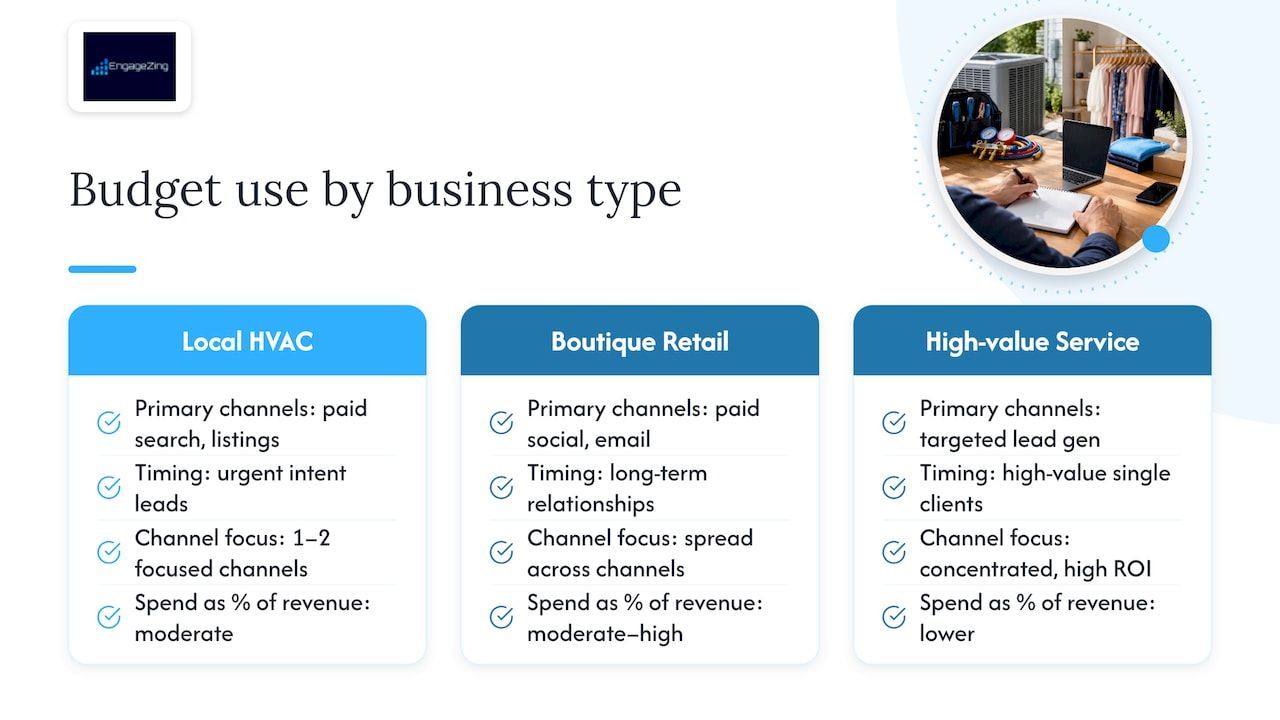
A $40,000 annual budget means something different depending on what you sell. A local HVAC company spending that much might put most of it into paid search and local listings, since customers search urgently when a system fails. A boutique retailer with the same budget likely spreads it across paid social and email, building repeat purchases over a longer relationship.
Service businesses with high-value customers, like law firms or contractors, often spend less as a percentage of revenue because each new client is worth thousands of dollars. A single well-targeted lead can justify a higher cost per acquisition than a retail business selling a $30 product ever could.
Smaller businesses, those under $1 million in revenue, tend to concentrate spend in one or two channels rather than spreading thin across five. A tighter budget rewards focus: one channel run well beats five run poorly. Larger small businesses, those approaching $5 million or more, usually have enough budget to test new channels while a core mix keeps revenue steady.
The U.S. Chamber's Q3 2025 data]( https://www.uschamber.com/sbindex/2025-Q3/quarterly-spotlight). This priority holds across industries, even when the dollar amounts and channel choices look completely different.
Handling tight budgets and prioritizing what matters
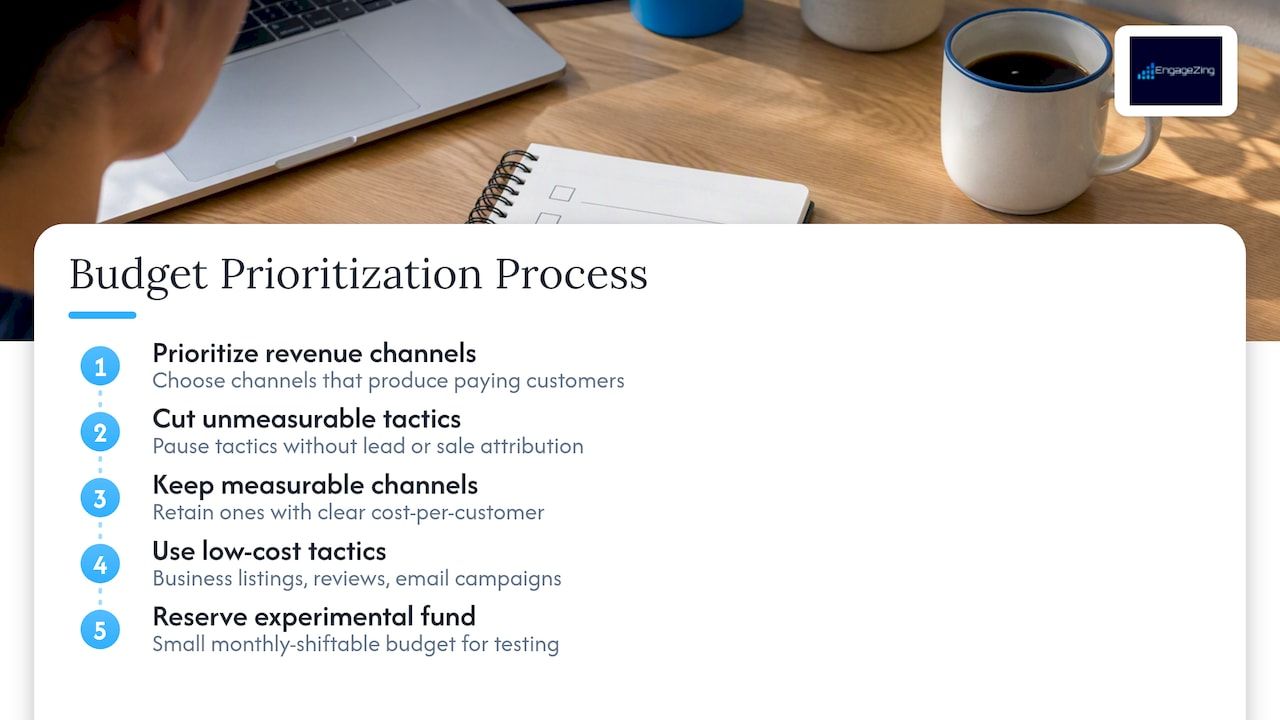
When cash is limited, rank your marketing activities by how directly they connect to revenue, not by how much attention they get. A channel that reliably produces paying customers earns its spot first, even if it's unglamorous.
Cut or pause anything you can't measure. If you can't tell whether a tactic produced a lead or a sale, it's the first thing to trim when money gets tight. Keep the channels with a clear cost per customer, even if that means running fewer of them.
Low-cost tactics still deserve a place in a constrained budget. Claiming and optimizing business listings, asking happy customers for reviews, and sending regular email campaigns to an existing list cost little beyond time, and they often outperform paid channels on cost per customer.
Industry voices increasingly describe tight budgets as a portfolio problem: protect a small experimental fund while funding the channels already producing revenue, and stay ready to shift money monthly rather than waiting for a full budget cycle, a pattern noted in Gartner's CMO spend research. That flexibility matters more when the budget is small, since a single bad month in one channel has a bigger relative impact.
Tools and software for tracking your marketing budget
A spreadsheet works fine for a first-year budget, but most small businesses outgrow it once they're running more than two or three channels at once. At minimum, track planned spend, actual spend, and cost per customer by channel, updated monthly.
Ad platforms themselves, including Google Ads and Meta Ads Manager, show spend and conversion data in real time, which makes them a reasonable first stop before investing in separate software. For businesses running print, signage, or other offline campaigns, a QR analytics platform like QRlytics can connect physical marketing to actual calls and visits, closing a gap that online dashboards can't cover on their own.
Whatever you use, the goal is the same: one place where you can see planned budget against actual spend and actual results, updated often enough to catch a problem before it burns through a quarter's budget.
Building an annual marketing plan and review schedule
An annual plan doesn't need to be long, but it does need specific numbers attached to specific goals. The SBA recommends setting measurable targets and checking marketing costs against the revenue they generate, rather than just tracking activity, according to SBA planning guidance.
Start with your annual revenue goal, then work backward through the budgeting math covered earlier to land on a dollar figure. Break that figure into quarters so you can adjust for seasonal demand instead of spending evenly across months that don't perform evenly.
Review performance monthly against cost per lead and cost per customer, and do a deeper quarterly review that asks whether the channel mix still matches where your customers actually are. An annual plan written in January and never revisited again usually misses real shifts in cost per click or customer behavior by midyear.
Adjusting your budget as your business grows
A startup building its first customer base usually needs to spend a higher percentage of revenue, since there's no repeat business or referral engine yet to lean on.
A growth-stage business with steady repeat customers can often shift some spend from pure acquisition toward retention tools like email and loyalty offers, while still testing one or two new channels. This is usually where the 70/20/10 style split, covered earlier, starts to make sense.
The American Marketing Association notes that benchmarks work best as guardrails adjusted for stage: new-market entry calls for higher test budgets, while established firms can often reduce broad brand spend in favor of performance channels, per AMA budgeting guidance.
What the benchmarks don't tell you
A business spending 5% of revenue with a tight, well-measured channel mix often beats one spending 10% without clear tracking.
The bigger gap isn't between businesses that spend a lot and businesses that spend a little. It's between businesses that know their cost per customer and businesses that don't. Most of the budgeting advice out there focuses on finding the right percentage, when the real leverage sits in measurement: tracking offline conversions, separating fees from media, and reviewing numbers monthly instead of annually.
If you take one thing from this guide, make it this: pick a defensible starting number using the methods above, then spend more energy on measuring what that money actually produces than on second-guessing whether the percentage itself is perfect.
— Joe Leineke
Get a free roadmap for your marketing budget
Picking the right percentage only gets you so far without a clear view of where your current marketing is leaking leads. EngageZing's free Roadmap Analysis reviews your account data and builds a custom 12-month Growth Roadmap around the numbers specific to your business, at no cost before you commit to anything.
If your website itself is part of the problem, a Winning Websites review can show whether conversion issues are costing you more than your ad spend ever will. Request your free Roadmap Analysis today and get a plan built around your own numbers.
FAQ
What is the 70/20/10 rule for marketing budget?
It's a guardrail referenced in practitioner summaries tied to The CMO Survey, not a fixed requirement for every business.
What is the 70/30 rule in marketing?
Treat it as a starting ratio to adjust once you know your own cost per customer.
What is the 60/40 rule in marketing?
This rule isn't tied to a single standard definition in marketing budgeting, and no major source in this guide covers it directly. Businesses sometimes use it informally to split budget between brand-building and direct response activity, but the 70/20/10 framework above has stronger backing.
How much does it cost for a small business to advertise?
Advertising costs vary widely by industry and channel, but a reasonable starting point is 7% to 9% of annual revenue for total marketing, based on benchmarks from The CMO Survey. From there, convert your annual figure into a monthly and daily number using the 30.4-day multiplier from Google Ads guidance to set realistic daily spend targets.
Sources
For a free, personalized look at your own marketing budget, visit Grow for a free roadmap analysis.
Recommended
Editorial Note: Content on this blog is generated with AI assistance and independently reviewed and fact-checked by human marketing professionals for accuracy and quality.
Recent Posts